





Veilwraith Solo Board Game Review – This Should Have Been One Box
An Early Impressions review of Veilwraith by wakasm — based on 3 plays
What Is This Game… Veilwraith?
Veilwraith is a solo focused card game played as a campaign of short scenarios called Vignettes. Each session… your goal is simple on paper. You need to defeat all the required foes (this varies), collect five keys, and then escape through a portal. If your spirit hits zero or you encounter the Archfiend, you lose immediately. (sidenote: there may be some changes to this format later in the campaign, but I wouldn’t know… I stopped after about 3 games).
Each round is very procedural. You reveal a threat, draw a card from your own deck, then activate one of three actions: Explore, Fight, or Influence. You only get a single action per round… unless you use some powers/keys to give you more, but you can tilt actions to store power for later which seemed like a promising utility option for later. The twist is that these three actions rotate through values of 1, 2, and 3, so timing matters. Using an action when it is sitting under a 3 is far stronger than when it is under a 1. You might have seen a similar version of this in the popular game Ark Nova.
On paper, that action system is the hook. The rotating actions make timing matter, and it feels like planning ahead should be important and should lead to some interesting choices and maybe even combos. Over the course of a campaign, you are supposed to upgrade your deck with Memories, manage limited retries through Ribbons, and slowly grow stronger as the challenges escalate.
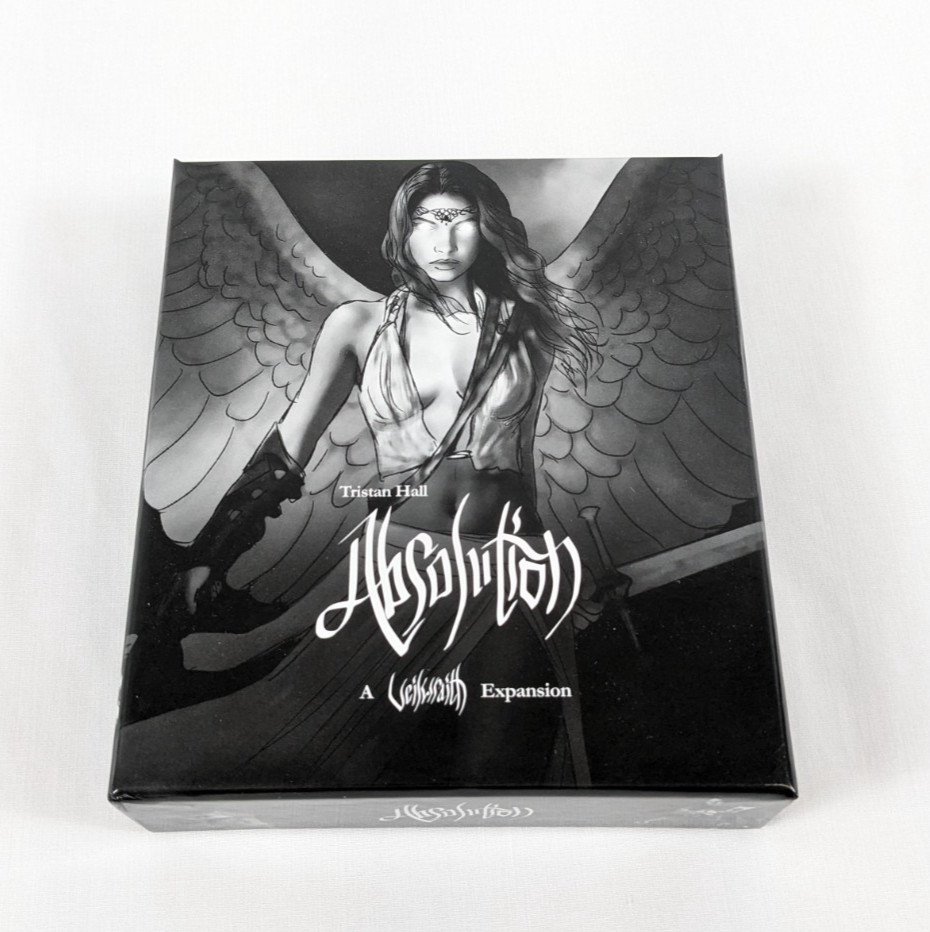
The base game includes five Vignettes. The Absolution expansion adds around fifteen more.
What I Liked About Veilwraith
The core action system is genuinely interesting.
The rotating Explore, Fight, and Influence actions felt fresh the first time I played. Deciding when to act, when to tilt, and when to wait for a stronger position gave the game a unique rhythm. It immediately reminded me of other games that do tempo really well, and early on I thought this mechanic was going to be the foundation for something special.
My first play was actually pretty positive.
That initial run surprised me. I liked the general flow at first… managing the threat deck, and the tension of watching spirit drain if I left too many problems unresolved. I especially liked the action mechanic and it felt fresh at first. At that point, I fully expected the campaign to build on this in meaningful ways.
There are some real strategic considerations.
You do have to learn what enemies do, what keys do, and when to use certain effects. Some threats reshuffle decks or punish bad timing, and knowing those ahead of time does matter. There is a puzzle here, even if it is narrower than I hoped.
Lots of official difficulty options.
If you want to make things easier or much harder, the game gives you a ton of ways to do that. For the right player, that flexibility is a plus.
Production is fine.
Nothing is broken or cheap feeling. Everything works.
What I Didn’t Like about Veilwraith
This did not need to be split into a base game and expansion.
This is the most glaringly non-gameplay issue that jumped out at me immediately and is honestly one of my biggest issues. Veilwraith should have just been a single box with twenty Vignettes. The base game alone feels too small, and the expansion feels mandatory. The box is also way bigger than it needs to be for what is essentially a card game with some chits. The value proposition feels off, especially for how niche the game already is. Take my thoughts with a grain of salt though because I didn’t even play through the entire core box. I’m keeping it in hopes that maybe one day I do but this is already on the cull list if I need to make room. I tend to be a completionist and I should probably fight the urge to do so.
The campaign progression felt flat.
This was the biggest disappointment. Because this is a campaign game, I expected meaningful growth between vignettes. I thought I was starting with a basic toolbox and would end up with something mechanically wild by the end with some sort of power curve. At least in the first three games, that never really happened, and looking over the cards and reading others impressions of the game, I don’t think it ever does. You are supposed to be able to upgrade the power numbers and the actions… but from what I read it doesn’t even happen in the base game (which again, since I didn’t play, this could be wrong, but I was already more than halfway through it and it hadn’t happened yet!)
The first game felt good…
The second game felt very similar to the first game…
By the third game, I felt like I was going through the motions.
The upgrades exist, but they feel minor and linear. I kept waiting for the game to open up, and it just never did.
Randomness outweighs agency more than I wanted.
Don’t get me wrong, I actually like randomness in games. And yes, there is some deck construction logic, and yes, you can roughly predict when keys might show up. But moment to moment, the game often feels like you are reacting rather than truly steering. For a game that flirts with deckbuilding and engine growth, that lack of control was disappointing.
The worldbuilding did not land for me at all.
The setting is abstract, end of the world, dreamlike, memory based, but none of it really connected to me t all. You are supposedly navigating the remnants of a ruined world, but it never felt like a fantasy quest and the rules of the world made no sense to me. It felt vague in a way that never paid off which I suppose is fine, it wasn’t advertised for it’s narration (although original on the box it was worded – “Veilwraith: A Solo Fantasy Quest Game” and it was changed to a “Veilwraith: A Veil Odyssey Game” which thematically means even less to me…)
Visually, the black and white art is a… bold?… choice, and I respect that. But the artwork itself was a mixed bag for me. The art looks good but there is something uncanny or off about the art. The style is very specific, and I think you either love it or you are somewhere in the middle like I am. I don’t really know how to explain it. It feels to me (even if this is untrue) that someone tool peoples images and then made them a little fantastic or fantasy-like. I’m sure there is a word for this style of art and I don’t know what it is.
The rulebook could have been much better.
The rules themselves are not that complex, but the book really needed more examples and clearer turn walkthroughs – especially with images. There were hardly any images at all in the rulebook. For a game so art centric, it’s unclear why the rulebooks do not get the same treatment. In the end… I got through it, but it felt like more effort than it should have been for this level of complexity.
The expansion does not look like it fixes the core issue.
I skimmed ahead, and from what I could tell, things do not ramp up in a meaningful way, even with the Absolution expansion. It adds more powers, more cards, more enemies… but.. the jump from 5 to 20 Vignettes is a big ask if the core experience does not evolve much. That makes it hard to stay motivated. Compared to something like Arkham Horror where every campaign is wildly different or even some other games where there are attempts to change up the formula, I wasn’t seeing it, but again, I didn’t play the full thing to fully know if it ever does. I’d love to be wrong here.
Final Thoughts about Veilwraith
Veilwraith feels like a game with a strong core idea that never fully delivers on its promise. The action system is clever. The first play is intriguing but I had a hard time staying longer with it for the campaign and gameplay payoff. It very quickly felt very samey and the fun-factor was not there for me to keep pushing through.
It is not a terrible game although this review is probably written like it is a terrible game. There definitely is some personal preference shining through here but I can’t help but believe your average buyer would be in the same boat as me on this. It is definitely not a great game. I wanted it to grow into something deeper, something more ambitious over time, and it just did not get there for me in the plays I did have.
It also promises the potential to be played coop with more copies and while I don’t want to judge it too harshly without playing that mode… I can’t see it improving any aspect of the game (and in some ways, could make it worse).
I am still holding onto it, mostly out of hope. Maybe a full campaign changes my mind. Maybe it clicks later. But right now, it feels like a solid concept stretched too thin, especially with the base game and expansion split. It’s definitely on my cull list and I would not be surprised if it’s gone from my collection in the near future.














Disagree With Me Here
Discussion and disagreement are welcome here — that's what makes talking about games fun. Just keep it kind. Attacks on people, not ideas, will be removed.