



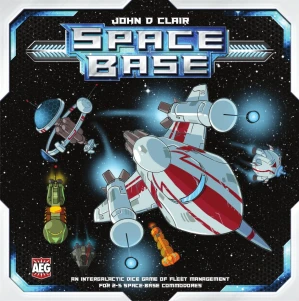


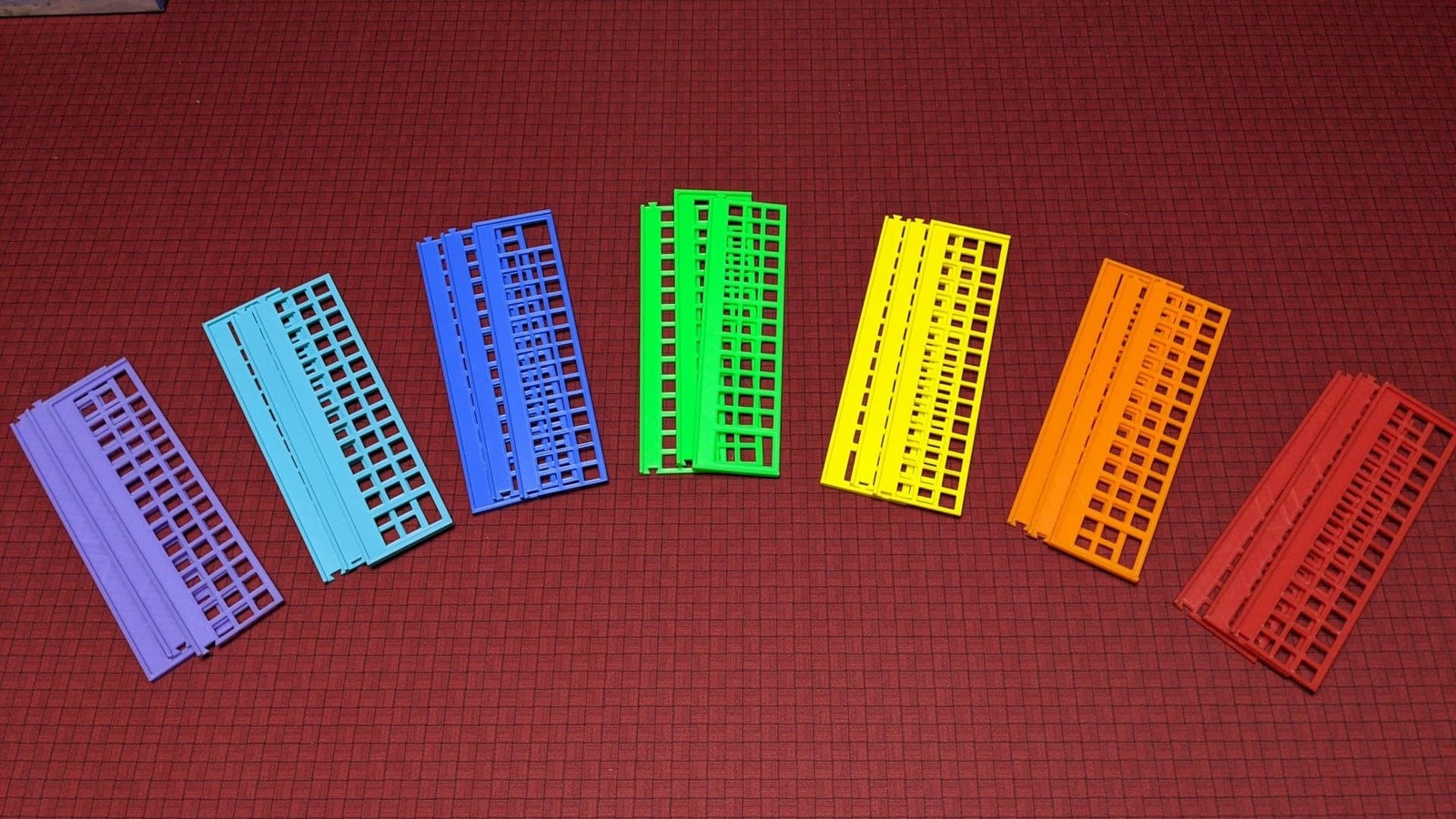


Space Base Review: A Great Engine Builder That Ends A Little Too Soon
A Space Base review by wakasm
I have a real fondness for Catan. I know a lot of people have moved on from it, or decided it is not a good game anymore and does not belong beside modern board games, but I kind of disagree. I still think it is a decent, fun game, especially with some of the heavier and later expansions. I have not written about Catan yet, which is something I am going to have to do at some point, but it is still the comparison I keep coming back to with Space Base.
A lot of games have borrowed the part of Catan where two dice are rolled and the result can matter to everybody. Machi Koro is an obvious one. The fantasy game I could not remember while putting these notes together was probably Valeria: Card Kingdoms. On the surface, this seems like a mechanic that should be easy to steal and improve, but I have found that most games trying it are never really as good as Catan. Space Base comes close. Sometimes I think I like it more than Catan, and sometimes I think I like it less. It depends on who I am playing with and how that particular game develops.
What is Space Base?
Space Base is a dice-driven tableau and engine-building game where players buy ship cards, place them into numbered sectors, and build combinations that produce money, income, victory points, or special effects.
- On your turn, you roll two dice and choose either to use their total or activate each die separately.
- Blue rewards activate on your own turn, while red rewards activate from deployed cards when another player rolls.
- After resolving the dice, the active player may buy one ship card from the market and place it into the matching sector.
- The card already in that sector is deployed underneath the player board, exposing its red reward for future turns.
- Money pays for cards, income establishes how much money you recover after a purchase, and victory points move you toward the end of the game.
- The game ends once a player reaches the required victory point threshold, with the remaining turns completed so everyone has played the same number of turns.
The most interesting twist is that decision to use the dice together or separately. If I roll a 4 and a 3, I can activate the 7, or I can activate the 4 and the 3. That gives me more options than Catan’s normalized distribution from 2 through 12. I can stack a single sector and potentially get output from it twice… or I can build toward the harder-to-roll totals and use card powers (or luck)to make those sectors more reliable and get stronger rewards.
What I like about Space Base
Everyone cares about the dice
The best positive is obvious: everyone is usually engaged because the dice matter whether it is your turn or not. Blue abilities trigger on your turn, and the red abilities underneath your board trigger on other players’ turns. Instead of rolling and then watching everybody else mentally leave the table… you roll and the whole table checks what happened, well, usually anyway.
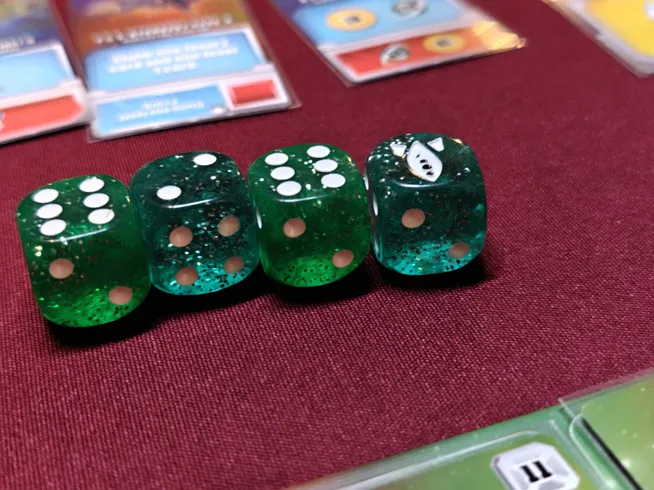
That gives Space Base some of that Catan feeling without being full-on Catan. You are not getting locked out by somebody’s roads or discovering that the board has closed around the place you needed to build. You don’t have to worry about the robber or trading either. There is luck, but there is almost always something to watch and some possibility that another player’s turn will help your engine.
The split-or-sum decision makes probability interesting
Letting me use each die or add them together is a small rules change that creates a lot of room for strategy. I can spread my engine across reliable individual numbers, stack the same number and hope to hit it twice, or build around totals and compensate for the probability with arrows and other powers.
I really think Space Base is a great introduction to probability in board games. A 12 is hard to roll, but that does not mean a strong 12 card is useless. The game gives you ways to abuse those harder sectors by redirecting activations, moving cards, swapping cards, or building chains that make a rare result much easier to reach. It teaches probability without making the lesson feel like homework.
The combos can be genuinely satisfying
There is a satisfying, if light, engine underneath all of this. You can go all in on one number and hope for jackpot rolls, stack arrow cards so one activation keeps moving toward a stronger card, or combine powers that move cubes and swap cards. A lot of the fun is seeing a card that looks difficult to trigger and figuring out how to make it practical. Most are surface level and obvious after a play or two but the fact they exist still is great.
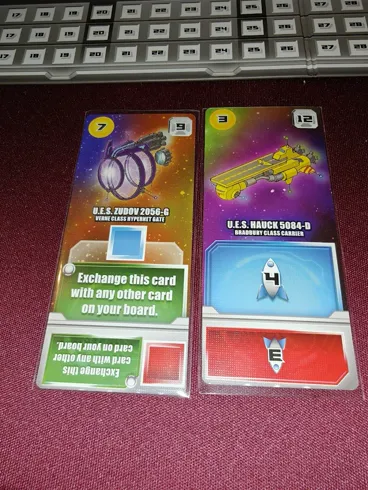
One of my favorite combinations is getting an important card in the 12 sector and then using the swapping power that I think starts on a 9. If I move that swapping card to the 2 and then use it to exchange the 2 with the 12, suddenly that powerful 12 is sitting on a 2 and is very easy to roll. I could also move it to the 7 and take advantage of the most common total. Once cards are deployed to their red sides, additional players can make some of these combinations trigger even faster.
That is where watching other boards starts to matter. Most of the time, everybody is building their own machine, but if I ignore somebody else’s setup, I can absolutely let them finish a combo that wins the game. Space Base is not highly interactive, but it is also not a game where I can safely stare at my own board for the entire session. I don’t always love hate drafting but that can/does exist in this game with certain players.
The economy is forgiving
The income system is one of the friendliest parts of the design. When I buy something, I spend all of my money, but then I return to wherever my income marker is. If I have 11 money, buy a card that costs 11, and have 3 income, I begin again at 3. It effectively feels like a 3-money discount on the next cycle.
If I raise income high enough, I can reach a point where I buy something every turn without needing to produce more money first. That lets me focus more heavily on points or other effects. There is very little sense of being completely locked out of the game, and that directly addresses one of the things people seem to hate about Catan.
That said… I do think income is probably the weakest major strategy because Space Base gets fast once it starts moving. Investing in future buying power is less appealing if the game is going to end before that investment pays off. Still, as a system, it keeps turns moving and makes a bad stretch of rolls feel less punishing. But it does suffer from what a lot of these gateway-y games suffer from. There are strategies that are better than others that really are hyper focused on efficiency. Ticket The Ride has the hoard all the tickets strategy, Dominion has Big Money strategy, Splendor skipping the low level cards, etc etc etc. so there is a little bit beware there if you play with those kinds of gamers.
It is easy to get played
Space Base has a pretty quick setup, high replayability, and is easy to teach. I was able to teach it to my seven-year-old, and he seemed to like it so far. We are going to try playing it more this week.
That accessibility matters. The game has enough card interactions to make me care about the engine, but the basic turn remains roll, resolve, and possibly buy a card. It is not hard to get somebody into the rhythm of the game, and the fact that their board can activate during other turns helps keep a new player involved.
What I don’t like about Space Base
The cubes are far too easy to knock out of place
My biggest straightforward production complaint is the three cubes on the player mat. They track money, points, and income, and they are very easy to knock out of place. A small bump in the table can leave me trying to remember whether I had 11 money or 12, or whether that point marker moved one space farther than it should have. Play with a 7-year old and you better start saying numbers out loud otherwise you will lose your place very often.
This is exactly the kind of game that could have used dual-layer boards, dials, pegs, or… I do not know, something that holds the trackers in place. I do not have the perfect manufacturing solution, but loose cubes on three important tracks are probably the biggest clear negative in the box.
The little cards are clever and fiddly at the same time
The small, thin cards are cool and unusual. They let the game fit a large market and twelve sectors in a reasonable amount of space. The problem is that I am constantly sliding those cards underneath the player board as ships deploy, and once a bunch of them are under there, the whole display becomes easy to disturb.
Sleeved cards make sliding them underneath the board even more noticeable. None of this ruins the game, and the little cards do feel cool, but a bump on the table can mess up the cards and the tracking cubes at the same time. The production has a nice compact idea without quite giving the player enough protection from ordinary table movement.
The space theme barely matters
The theme is very generic. It is a space game because the art and names say it is a space game, but there is not much happening mechanically that makes me feel like I am running a space base. I am mostly buying numbered cards and assembling an engine.
There are expansions, and I have not played enough of them to know whether the theme comes through more strongly there. I own two of them. One is a small campaign and the other mostly adds things, but I do not want to judge either one before I get it properly played. I want to get all the Space Base expansions to the table eventually, rank them, and talk about what they add.
The complication is that campaign expansions are at their best with the same people returning. I do have a steady group that plays recurring games, but Space Base just is not a game they particularly want to keep playing. Otherwise, I am often playing with different people at meetups or playing solo. I am sure some kind of solo variant exists, but solo Space Base is not something I think I would want to do.
Luck can decide who gets the exciting card
There is some market-luck dependence. I like luck in my games, so dice being random is not automatically a complaint from me. If somebody hates luck, though, they may not be happy with both random rolls and a random card market.
The market can reveal a card that feels extremely powerful, and if I cannot afford it, somebody else can grab it before I get another chance or vice versa, it shows up and you snap it up without any competition as later in the game you get to purchase almost every round. That can feel a little bad. Strategy still matters because I can build around probability and watch what opponents are saving for, but sometimes the right card appears for the person already in position to take it. I’m not sure if higher costs and/or a 4th tier or something would fix it but it does exist.
Interaction often means denying somebody else
There is not a lot of direct interaction. I remember one card (U.E.S. Gordon, a sector 7 card) that can take points away from everyone when it activates, and I have seen people online say they remove it. I think it is fine although it probably could have been a higher number to activate – like a 9 or 10. You can play around it. I do not know whether the expansions add much more direct interaction, but the base game is mostly people doing their own thing.
The interaction that does exist often becomes hate drafting… if people are paying attention to do so. If somebody is at 13 money and the 16-money yellow victory ship is sitting there, taking it before they can may be the best move. If somebody has a great effect in sector 12, buying the arrow cards they need may stop their engine. Sometimes I need to buy a card because it is too useful to another player, even if it is not the best card for me. I don’t think most people play this way, especially at higher player counts but at lower player counts, it’s very doable and possible.
I always like the idea of hate drafting because it adds a strategic layer, but I do not really love doing it. I tend to prefer games where denying somebody is not routinely my best move. Space Base does not make hate drafting constant, but an advanced group should be watching for it because a completed combo can end the game very quickly.
Two players needs help
At two players, I’ve used the dummy variant where player one goes, then the dummy, then player two, then the dummy. And I am someone who doesn’t enjoy variants that much… but this one felt very obvious. That creates more opportunities for red powers to trigger and makes the rhythm resemble a four-player game.
It is better than playing completely heads-up, where red cards rarely activate and both players rely more heavily on blue powers, but it also shows why this is not the greatest two-player game. I mostly play at two or three, so I am glad the dummy option exists. It fixes part of the activation problem without making Space Base feel like it was designed primarily for two.
The game starts slowly, then ends too quickly
The opening can be slow, especially with four or five players. There are variants, and maybe an expansion(?), that can speed it up. I personally do not mind the slow start because I already think the whole game is too short. Still, I understand why waiting through those early turns can bother people more at larger player counts. But it being too slow is somehow still the complaint I see the most. I can agree with the start but the whole is too fast.
My biggest design criticism is not really the slow opening. It is that the things I am aiming for are too streamlined, so the game ends right when the engine becomes interesting. It is easy to save money because I do not have to spend it. I can wait a turn or two, skip the tier-one ships, and buy something much stronger from tier three. It reminds me of the Splendor issue where sometimes it feels better to skip the level-one cards and go straight toward level two.
Then the scoring accelerates. It feels like the game goes from 0 points, to 0 points, to 1, then 5, 15, 20, 30… and it is over. Sometimes there are ties, and those endings can be fun, but there is not much room in the middle for a player to catch up or for a great engine to breathe. It only really happens if the dice roll weird, which, doesn’t happen often. I don’t think I’ve seen like back to back 12’s change the outcome of the game (as an example) and generally, even if they could, someone likely has padded the six spot already to double on them. Any kind of points in the red side of things basically turns the game into a timer.
I say this a lot, but I want a game that uses this as its foundation and then goes one extra level in length. Maybe the victory point target is higher. Maybe winning requires generating a certain number of points in one turn, reaching a money target, or completing an additional condition. I do not know what the answer is. These engines naturally go up and up, and once one of them starts climbing, that may simply be the end. There is even a card that can win the game immediately if its condition goes off, which makes it another card that the table cannot afford to let somebody complete.
That said… I am not sure how to fix this without making the game drag or making an overpowered combo even more overpowered. I just know that I want more time in the part where the engine exists but has not already decided the winner.
Review Thoughts
The expansions are still an open question for me. I have heard good things about them, and I want to play and rank all of them, but I need the right recurring group to get the most out of the campaign material. Until that happens, this review is about the base game and the two-player dummy variant I actually use, not a judgment on the full expansion system.
I also need to write about Catan eventually. Space Base keeps pulling me back toward that comparison because it takes one of Catan’s most engaging ideas and removes some of the blocking and resource starvation. That does not automatically make it better. Sometimes I prefer Space Base, and sometimes I prefer Catan, especially once Catan’s heavier expansions enter the conversation.
Final Thoughts about Space Base
I really like Space Base, even though I have a fair number of complaints about it. It keeps everybody engaged, makes probability easy to see, gives me satisfying combos to discover, and is simple enough that I could teach it to my seven-year-old. The split-or-sum dice decision is smart, the economy is forgiving, and turning a difficult sector into an easy jackpot is exactly the kind of engine-building moment I want from it.
The frustrating part is that the physical game is easy to bump, the theme does very little, two-player needs a dummy, and the most interesting engines can arrive just as the scoring explodes. There is luck and there is hate drafting, but neither one bothers me as much as feeling that the game stopped a few turns before I was ready.
For my tastes, this is still a really good game. Sometimes it comes close to replacing Catan for this kind of shared dice-roll experience, and sometimes it makes me appreciate what Catan still does differently. I want to keep playing Space Base, try it more with my son, and eventually see whether the expansions give that engine more of the middle that I keep wanting.
Do I Recommend Space Base?
Yes. I really like Space Base, especially as an accessible introduction to probability and engine building, even if I wish the game lasted longer once those engines finally get moving.



















Disagree With Me Here
Discussion and disagreement are welcome here — that's what makes talking about games fun. Just keep it kind. Attacks on people, not ideas, will be removed.