






Morbid Fortress Review: A Great 18-Card Idea That Needs A Tiny Bit More
An Early Impressions review of Morbid Fortress by wakasm — based on 3 plays
I like the idea of Morbid Fortress a lot.
That is probably the cleanest way to start, because this is one of those small print-and-play games where the system immediately makes sense to me. It is 18 cards, everything is double-sided, and instead of writing on one roll-and-write sheet, you are writing across these little sleeved cards. Resources, construction, damage, repairs, powers, scoring, it all lives on the cards. That is neat. I played it digitally because I am usually not into the crafting side of print-and-play, but even digitally, I could see the appeal of the format.
Note, it’s not AVAILABLE digitally but it’s very possible to do a self-setup solution or use something like tabletop simulator or playingcards.io to play them if you own the files for your own personal use.
When thinking about reviewing the game… the part I keep coming back to is that Morbid Fortress feels like a really good foundation. I like the dice. I like the crafting. I like the grim little buildings. I like the idea of crusaders building up pressure while I am trying to get this horrible necromancer fortress online. That said… I just also kept wanting the game to go one layer deeper than it does in complexity and agency. Not in a “make this bigger just to make it bigger” way, but in a “this system seems like it could support more interaction, more combos, and more agency” way.
What is Morbid Fortress?
- Morbid Fortress is a solo 18-card print-and-play game from Nathan Meunier of Doom Thoughts.
- The game uses sleeved cards and a dry erase marker. Four cards track crusaders, rounds, resources, and crafting, while 14 construction cards form the building deck.
- Each construction card has an unbuilt side and a built side. You buy buildings from a shop row, mark resources onto their recipe grid, then flip them when completed.
- Each round has three phases: roll, production, and crusader.
- In the roll phase, three dice can increase crusader attack or holy strength, mark future crusader attack rounds on the rally track, and harvest resources.
- Basic resources can be crafted into advanced resources like metal, blood, and haunted skulls, or turned into repair and salvage actions.
- Finished buildings can provide shields, magic, damage slots, one-time powers, end-game scoring, or special effects such as gaining resources when they absorb damage.
- If crusaders attack, your completed shields and magic reduce their attack and holy strength, then your completed buildings can absorb damage.
- Unblocked damage increases the crusader power track. If that track fills, you lose immediately.
- If you survive to the end of the round track, you score undamaged building spaces and completed building bonuses, then compare your score against the crusader power track.
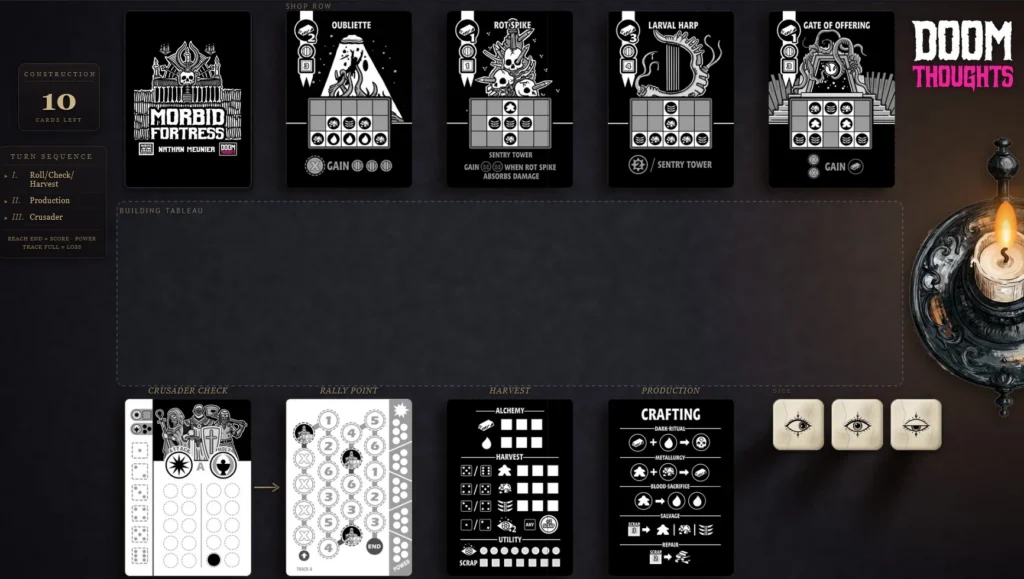
That is a lot for 18 cards, but it is not hard to understand once it is moving. The biggest learning wrinkle for me was that you have to buy a construction card before you can start building it. I messed that up in my first recorded attempt and was applying resources to buildings I did not own yet. That was my mistake, not some giant rules problem, and I fixed it in the later play. The Rally track is also a little unituitive at first and you can easily forget to do this step and gain another round accidentally. At least.. .for me.
What I like about Morbid Fortress
The core crafting loop is the best part of the game
Getting resources, crafting them into better resources, buying buildings, then slowly marking off the little recipe grids just works. It is intuitive in a way I appreciate. You roll your dice, decide where those dice go, maybe spend eyes of influence to adjust a value, and then try to turn that into enough fortress to survive. Most turns are pretty small, usually three resources, maybe scrap, maybe a modified die, but that smallness makes every resource feel like it matters.
I also like how physical the build process feels, even when I played it digitally. Marking off the icons on a card until it flips into a finished building gives the game a nice sense of progress. It is not just “pay seven resources, get a card.” You see the thing taking shape. In a tiny game, that matters.
The best buildings hint at a more interesting game
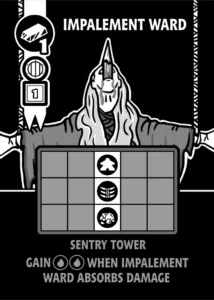
The Sentry Tower style cards are where Morbid Fortress feels closest to what I wanted from it. Impalement Ward, for example, counts as a Sentry Tower and gives you two blood when it takes damage that round. That is a fun little idea because blood is usually something you craft, so taking damage can become part of your resource plan instead of only being punishment. Skeletal Light does something similar with eyes of influence, and Rot Spike can generate bone.
That is the promise of the game for me. If I can build a tower, let it get hit, turn that damage into resources, and use those resources to build or score something else, now I am interested. That starts to feel like a gross little fortress engine where the bad thing happening to me can become useful if I prepared correctly. I wanted more of that.
The crusader tracker is a neat pressure system
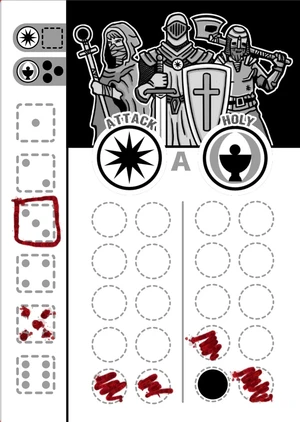
At setup, you roll for the crusader attack value and holy value, and those numbers become dangerous for the rest of the game. When you roll those values during the crusader check, the matching side gets stronger. Later, rally points can mark future attack rounds based on the dice you rolled. It feels unintuitive at first, but once I played through it, the idea clicked.
I especially like that the game gives you some prep time. On the easier side, at least, you can spend a bunch of early rounds buying, crafting, and trying to get your towers built before the real punishment starts. That makes the game feel less like instant survival panic and more like a race to get the fortress ready before the crusaders arrive in force.
The art and card presentation are probably what will sell people
The art is really nice. It has this black-and-white grimdark fantasy look that immediately tells you what kind of game this is trying to be. I think I liked the coloring in Doom Machine more, but I do not think many people are going to complain about Morbid Fortress visually unless they just do not like this kind of dark fantasy style.
There are also little layout touches that I liked. Ritual Chamber has this ritual-symbol feeling to the resource spaces. Hatching Pool looks like a pool, with blood icons sitting in a way that matches the theme. Impalement Ward lays the symbols out vertically, and the art is, well, someone being impaled through the mouth. It is dark. But the card gives you blood, so the theme tracks in a gross little way. None of that changes the gameplay, but it makes the cards feel more intentional than just a grid with some icons slapped onto it.
The price and footprint make the rough edges easier to accept
This is a small print-and-play game that costs $6.66. That does not magically fix every issue, but it does affect how I think about it. For that price, the game is smooth, readable, attractive, and playable. I do not feel burned by it. I feel like I tried a clever system that maybe is not fully my thing yet, but absolutely has something there.
I also appreciate games that try to do something interesting in a tiny footprint. Morbid Fortress does not feel like a random collection of cards pretending to be a full game. It feels designed. I just think the design is maybe sitting one step before the version I would personally love.
What I don’t like about Morbid Fortress
I wanted more combo depth and agency
My biggest issue is that Morbid Fortress feels a little more straightforward than I wanted. There are combos, especially around Sentry Towers and damage-triggered resource generation, but I kept wanting those ideas to stack in more interesting ways. I wanted three buildings to line up and do something weird. I wanted a couple aspirational buildings that feel almost impossible on their own, but become possible if I built the right support pieces first. Discounts, extra harvests, resource bursts, buildings that care about specific rolls, anything like that could have made the system sing a bit more for me.
As it is, my plays felt more like “get the right tower and survive” or “get the wrong tower and struggle.” There is still decision-making in which cards to buy first, when to use one-time powers, and how much to repair, but I did not feel like I had enough ways to push past the normal three-resource rhythm of a turn. There were turns near the end where I knew a building needed seven resources and I had two turns left, and it felt like the answer was just “well, you cannot do that.” Sometimes that is fine. Here, I wanted one more tool to try anyway.
The shop and card flow can feel too opportunistic
There are 14 construction cards in play, and the shop row gives you four options if you count the top card of the deck. As far as I can tell from the rules, The Grinder is the main way to flush the shop, and you have to buy and build it before you can use that power. In my games, I only bought maybe five or six cards at most, and the best strategy may be closer to building four good cards, repairing them, and hoping your defenses hold.
That means the row matters a lot. If you see a row full of scoring cards, it can be hard to get the resources and defenses needed to actually build them. If you see a row with no scoring, it can be hard to get enough points to win later. I do not think that makes the game broken. Small card games often live in that opportunistic space. It is just a little more opportunistic than I prefer, especially because the cards that look powerful can depend heavily on how the crusader dice develop afterward.
Some scoring cards felt easier to use than others
Ritual Chamber stood out to me because it gives one victory point for every unused basic resource at the end of the game. That seemed potentially strong, especially if you already have something like Impalement Ward helping you generate blood or you can just hold resources late instead of spending them. Since undamaged spaces on completed buildings are also worth points, and scrap can repair buildings for points in a roundabout way, unused resources scoring one each did not feel that far away from other normal scoring paths.
Ossuary, by comparison, felt more expensive and more committed. It gives two points for each haunted skull stored there, and the rulebook says haunted skulls usually must be spent in the same round they are crafted unless a construction lets you store them. A skull costs more work to create, and once it is stored there, it is not sitting in your reserve as flexible fuel for something else. Maybe this balances out over more plays, and I am not claiming I solved the math here, but my first reaction was that Ritual Chamber felt a lot easier to exploit than Ossuary.
The dice can make the same roll feel good and bad in a weird way
I like the idea that the crusaders care about two specific die values. The issue is that those same dice are also your harvest dice. If four and five are the values you want for the resources you need, but four and five also make the crusaders stronger, you get this weird emotional split where a roll is good for you and bad for you at the same time.
That can be interesting. I do not want to pretend tension is automatically a flaw. But in my plays, when the dangerous values overlapped with the best harvest values, it felt a little bad. I might try one play where I reroll dice for harvest after the crusader step just to see how it feels. Maybe it does not actually change much mechanically, because random values are random values, but separating the emotional hit might make the system feel cleaner to me.
Rally rolls can swing the difficulty a lot
The rally track is clever once you understand it, but it can create some pretty big swings. If you roll doubles or triples at the right rally point, fewer future rounds get circled, which means fewer attacks. That feels good when it happens. Of course it does. Taking less damage is nice.
But it also means one good rally roll can noticeably soften the game. On the easier side, that can make a win feel less like “I mastered the fortress” and more like “the crusaders did not show up as often as they could have.” I am not sure I dislike this, because random is random and sometimes that is part of the fun, but I could see myself house ruling doubles on the hardest difficulty just to see what happens. Maybe you reroll them during rally checks. Maybe that is a terrible idea. I do not know. I just noticed the swing.
Some strong-looking cards can whiff through no real fault of your own
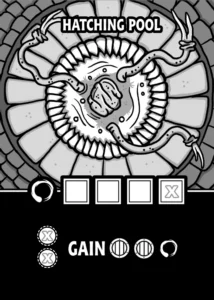
Hatching Pool is the example that stuck with me. It can give you two shields and one magic for use during a crusader attack, and it can be used twice per game. Shields and magic are extremely important because they reduce crusader attack and holy strength before damage gets assigned. If you get Hatching Pool early and the matching crusader side has built up, that power can basically reset a scary situation.
But in one of my games, I built toward that kind of power and then the attack side just did not develop in a way that made it useful. I ended up staring at this thing that looked like the obvious strong choice, except the dice never gave me the problem it was built to solve. You could argue that is my fault for investing early, but how would I know the dice would never roll that way? Alternatively, skipping would mean that it would be too late to take it because it’s a hard card to build. That is where I wanted a little more agency. If a card let me choose the shield and magic distribution when I completed it, or if more cards had mirrored versions, that one investment would feel less all-or-nothing.
I did not test the physical write-and-erase experience
I played Morbid Fortress digitally, so I cannot really say how annoying it is to write and erase on sleeved cards in person. My guess is that it is probably fine because a lot of the marking is minimal and you can erase as you go. But the game does ask you to flip cards, damage cards, repair cards, and wipe between games, so I can at least imagine the physical version having a little friction.
That is not a criticism from experience. It is just a caveat. If you are someone who loves crafting print-and-play games, sleeving cards, and using dry erase markers, you may actually enjoy the tactile part. I am not really that person, so I played it through a digital interface instead.
Final Thoughts about Morbid Fortress
Morbid Fortress is a good small game with a really good idea inside it. The resource system is smooth, the card marking works, the crusader pressure is interesting, and the art absolutely nails the dark necromancer fortress thing it is going for. I like the foundation here. I probably like the foundation more than I like the full game, if that makes sense.
For my taste, it needs one more layer. More building interactions. More ways to cycle or influence the shop. More harvest-phase powers. More push-your-luck moments beyond spending eyes to reroll or adjust dice. More ways to turn a bad situation into something clever because I built toward it, instead of hoping the right tower showed up and the dice rewarded the investment.
That said, this is still a $6.66 print-and-play that looks great and plays smoothly. I do not think it is a bad game at all. I beat the easy side, and I still need to see what the harder sides do before treating this like a final lifetime verdict. Maybe the harder setup creates more of the pressure I wanted. Maybe it makes the same swinginess stand out more. Either way, I am glad I played it, and I would be very interested in either an expansion or a future design that takes this exact write-on-cards fortress idea and pushes the combos harder.
Do I Recommend Morbid Fortress?
Yes, if you like solo print-and-play games, dark fantasy art, and small roll-and-write style puzzles with a clever physical hook. I would be more cautious if you need deep combo chains, strong card cycling, or a lot of agency over how the game develops.











Disagree With Me Here
Discussion and disagreement are welcome here — that's what makes talking about games fun. Just keep it kind. Attacks on people, not ideas, will be removed.