









Isle of Trains: All Aboard Review: A Clever Train Themed Game That Ends Too Soon
An Early Impressions review of Isle of Trains: All Aboard by wakasm — based on 4 plays
I played Isle of Trains: All Aboard multiplayer once and solo a few times, so my thoughts are a little weird on this one. They are not purely multiplayer thoughts, and they are not purely solo thoughts. It is one of those games where the most interesting thing about the multiplayer game is also one of the things that disappears when you play it solo, which makes it hard to talk about cleanly.
The short version is that Isle of Trains is cute, clever, more thinky than it looks, and I do like parts of what it is doing. But I also don’t know if I would call it a game I need to keep coming back to. It feels like a small-box engine builder that almost gets rolling… and then the game ends right when I want to enjoy the thing I built. That can be exciting, because it creates pressure, but for me it also left the game feeling a little more middle-of-the-road than I wanted.
What is Isle of Trains: All Aboard?
- Isle of Trains: All Aboard is a small-box train-themed card game where players take two actions a turn to build trains, load cargo or passengers, and deliver them for contracts and rewards.
- The core hook is multi-use cards. A card can become part of your train, cargo, payment, or part of a scoring plan, so every card has a little bit of opportunity cost.
- In multiplayer, the unique bit is opponent loading, where you load cargo or passengers onto other players’ trains to gain bonuses from their train cars.
- The game uses variable city bonus tiles, so the same map can have different combinations of locations and rewards.
- Solo has a beat-your-own-score mode, but the stronger part is the solo scenarios, which give you specific win-loss objectives.
- In solo, the Train deck is also the clock. Each Night Phase discards the top Train card, the solo discard deck is never reshuffled, and the game ends when the deck runs out.
What I like about Isle of Trains: All Aboard
It does a decent amount with a small box
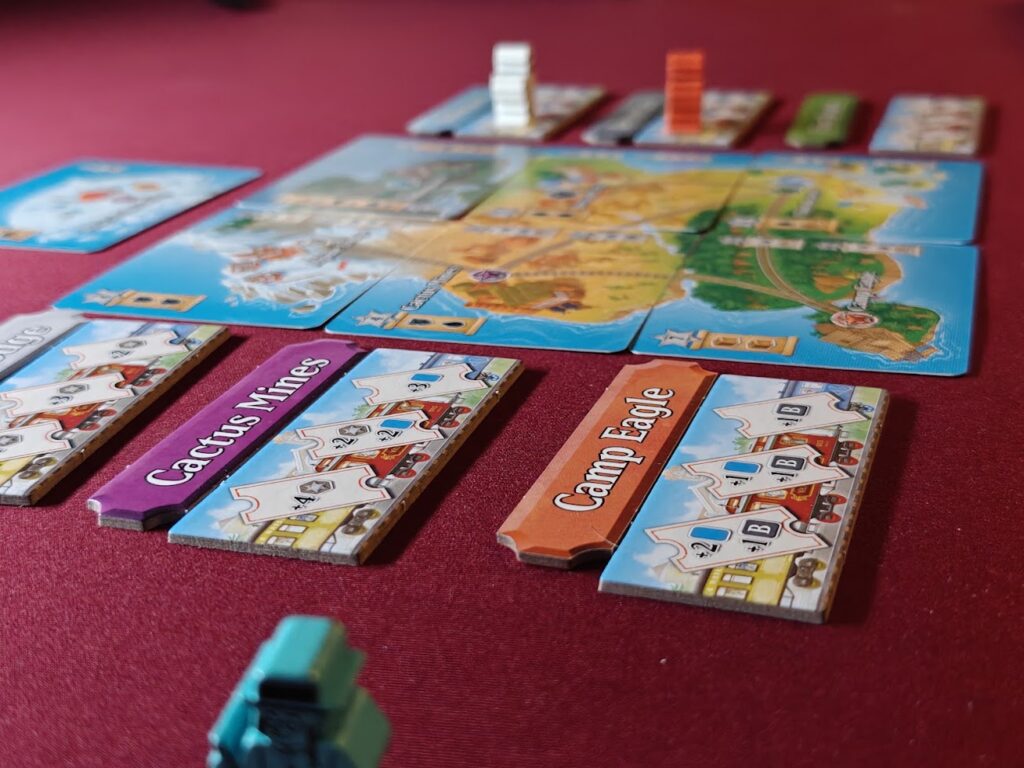
I wouldn’t call Isle of Trains some huge engine-building game in a tiny box, because that makes it sound bigger than it is. But it definitely has more going on than the box size might imply. It can fit in a bag pretty easily, the table presence is not massive, and most of the game is just cards, tokens, and meeples spread out in front of you. For that footprint, it has a surprising amount of decision space. You are building train capacity, deciding what kind of cargo you can carry, figuring out when to actually deliver, and trying to not spend the whole game making your train better while forgetting to score anything.
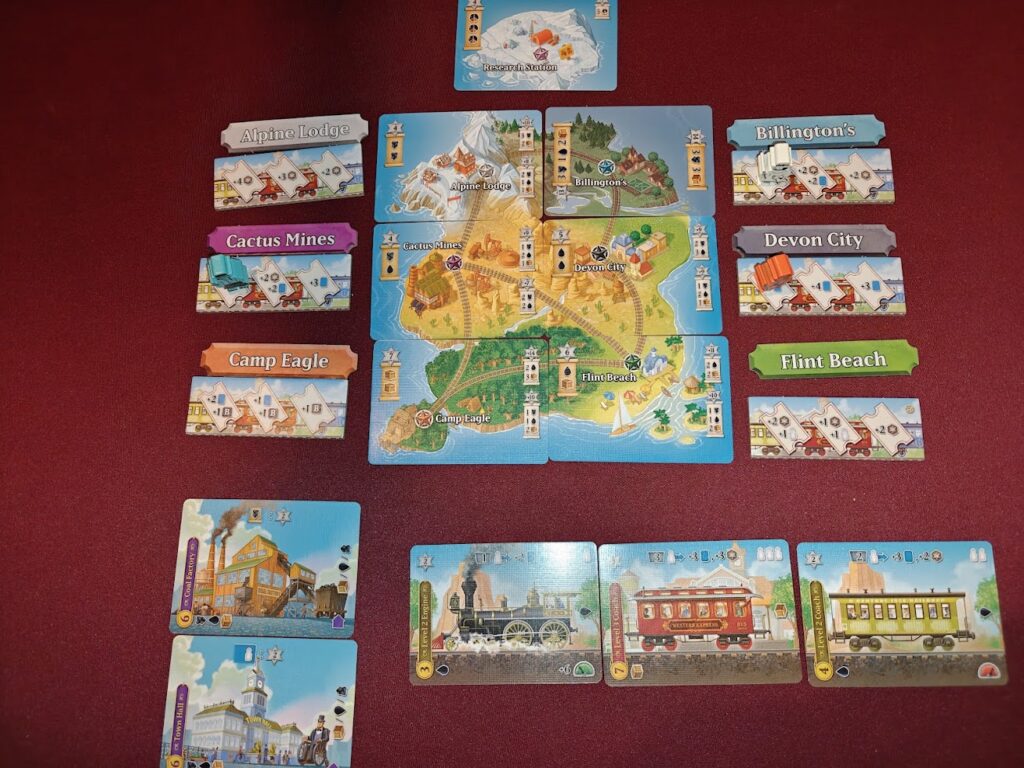
That loop works. You kind of want to keep expanding your train because the engine-building part is fun, but the game is always nudging you to actually fulfill contracts and goals. Do you build one more card because it will make future turns cleaner, or do you start delivering because the game is not going to wait forever? That is a good tension. I just wish the game gave me slightly more time to live inside it once the train starts feeling useful.
The multiplayer loading idea is genuinely interesting
The most unique thing in multiplayer is the way you can load cargo and passengers onto other players’ trains. That is not something I usually see in this type of game. Normally, you mostly care about your own little tableau, but here you are looking around the table because loading someone else’s train gives you the bonus. You might be helping them by giving them a resource, but you are also getting the card draw, extra action, or whatever that train car offers.
Conceptually, I like that. I don’t know if I think it is an amazing mechanic, but it is probably the most distinct part of the multiplayer game. It creates this semi-cooperative, semi-selfish moment where helping someone else can still be the best thing for you. The downside is mostly physical. The cards are small, the icons take time to learn, and if you are playing on a larger table, you are going to be leaning forward and asking people what their train cars do. That is not a theoretical issue either. That was part of my multiplayer experience. The idea is neat, but the usability has to fight the table a little bit.
The art and production are charming
The art is very cute. I will give it that. The colors are vibrant, the game looks nice on the table for what it is, and it has a charming look that works especially well because it is a train game without feeling like a typical train game. You are not laying routes across a map or doing a big economic train thing. It is more of a card-based train tableau with pickup-and-deliver goals layered into it.
That might actually be something to know going in. If someone sees a train game on the shelf and expects routes, networks, stocks, or something in that family, this is not really that. I don’t think that is a flaw, but it is a possible mismatch. It is more cute train engine puzzle than “train game” in the traditional board game sense.
The solo scenarios help a lot
The solo mode is saved by the scenarios. If Isle of Trains were only a beat-your-own-score solo game, I don’t think I would be very interested in it. I just don’t think that would be enough here, at least for my tastes. But the scenarios give it actual win-loss conditions, and that matters a lot. Some scenarios ask you to complete specific contracts. Some push you toward buildings. Some are score-based, but even those can work because they give you a target to improve toward.
I liked that the second scenario pushed me into a different part of the system, even though I lost it. Scenario one felt closer to the normal contract-delivery game, while scenario two made the deck pressure feel sharper because I had to build four buildings before time ran out. I probably needed one clean draw/build engine and then needed to stop building train cards way sooner. Classic me, I overbuilt the train and then wondered why I didn’t have enough time to win. But that is also what makes the scenarios interesting. They force you to explore the system from different angles instead of just asking you to beat your own previous score over and over.
Passengers and combos can feel fun
The way you deliver passengers feels neat and the variable setup with bonuses and the colored meeples has nice table presence. There are some combos you can pull off that make you feel like you get more out of your turns… but… getting the correct ones lined up before the game ends (especially in solo) can be somewhat hard.
What I don’t like about Isle of Trains: All Aboard
The game can end right when the engine gets interesting
My biggest issue is that the game often feels like it ends right when your train starts becoming what you wanted it to be. This happened in solo, and I think it can happen in multiplayer too because it is still a race. You spend the game building capacity, setting up bonuses, getting the right cargo options in place, and then suddenly the endgame trigger is there and you have deliveries unfinished or a train that finally looks useful but only gets one more turn to breathe.
That is not automatically bad design. A lot of engine builders are built around that exact frustration, where the timing pressure is the point. But in Isle of Trains, I felt that pressure more as a limitation than as excitement. I liked building the train. I liked seeing the little card engine start to make sense. I just wanted a little more runway.
The solo clock feels aggressive
For solo specifically, the clock is probably my biggest criticism. The stack of Train cards is not just your deck, it is also the timer. Every Night Phase you discard a card from that stack, the solo discard deck is not reshuffled, and when the Train deck runs out, the game ends. You are also drawing from that same system, so it creates this weird pressure where drawing cards is useful, but also terrifying, because you are moving yourself closer to the end.
There are ways to get cards back from the discard, so it is not like discarded cards are gone forever. But those recovery actions can feel like something you have to do rather than something you want to do. Maybe that is the point, and maybe other people will like that pressure more than I did. For me, it made the solo game feel a little too tight. I always felt like I was short on time, or like I had to play an efficiency puzzle instead of enjoying the train I was building.
The best multiplayer idea gets lost in solo
The other issue with solo is that the most unique multiplayer interaction basically disappears. In multiplayer, loading other players’ trains is the weird thing. That is the thing that makes the game feel different. In solo, you are loading your own train and getting your own bonuses, which is fine mechanically, and honestly maybe cleaner to plan around… but it loses part of the game’s identity.
So solo becomes more of a solitary efficiency puzzle. Again, that is not bad by itself. There are a lot of good solitary efficiency puzzles. But that is also the problem. Once the unusual player-to-player loading interaction is gone, Isle of Trains has to compete with a much larger pile of small solo games, scenario games, and engine-building puzzles. I don’t think it fully stands out there, even if the scenarios make it much better than a plain beat-your-own-score mode would have been.
The multi-use cards create both depth and slowdown
The multi-use cards are probably the reason the game is heavier than it looks. I don’t remember where BoardGameGeek has the weight exactly, but in my head this feels like something around a mid-2 weight. Not heavy because the rules are impossible, and not heavy because of deep player interaction, but heavier because every card asks a small question. If I use this as cargo, am I giving up a train car I needed? If I discard this to pay for something, am I locking myself out of a certain engine path? How many of this type of card even exist?
That is interesting, but it also creates analysis paralysis, especially when you are new. You don’t know the deck yet. You don’t know whether the thing you are waiting for is still coming, already discarded, or sitting in someone else’s hand. In multiplayer, this combines with the market and other players taking cards. In solo, it combines with the clock. Either way, it can make a small game feel slower and heavier than the table presence suggests.
The card market and group behavior can matter a lot
There is some card luck and market dependency here. If the right train cards or cargo options do not come up, or if other players grab them first, you can get hamstrung. I don’t think that is automatically a dealbreaker, because that is part of a lot of card-driven games, but it can feel rough when you are trying to build toward something and the game is already short.
Multiplayer also has a group-dependent issue because of the loading mechanic. If everyone keeps loading one player’s train, that player may get a lot of incidental help. If people dislike the idea of helping each other and refuse to load other players’ trains, the game can lose part of what makes it interesting. I don’t know if I would call that broken or anything, but it does mean the table has to buy into the game’s central weirdness.
Useful Combos can be harder to pull off
This game is an engine builder but because of the length of the game, how tight the game is, setting up an engine that you need to succeed (especially for the very specific solo scenarios) feels more like fishing than strategy at times.
Unless I am completely missing some aspect to the rules, strategy, or game… some of the scenarios will really require you to play, lose, then play again, until you get some of the train engines or other puzzle pieces required to make things happen the way you need them to happen.
I don’t mind this kind of play style, actually. I’ve played a lot of ARPGs, it’s not unheard of to beat the same boss over and over again dropping weapons until you get one that is rolled correctly… but… the game that wraps around that game loop matters.
The puzzle feels like you are putting 5 pieces together and shuffling them around
SPEAKING of puzzles… I don’t fully know how to explain it, but the game feels like a puzzle with only a few pieces… and all you are doing is shuffling those pieces around trying to make them fit. Maybe there aren’t enough variety between the train cars or there isn’t enough variance with how you score… but you almost always feel like you are aimed at just one of a few things, and game to game, you are just aiming for those few puzzle pieces in a specific order hoping to get them together before the game ends.
I find it hard to articulate, and I didn’t play the scenarios enough to know if there is some secret sauce that emerges with more plays… but it definitely felt like the game wanted to be deeper than it was while also being more complicated than it’s size (because of it’s multi-use cards).
The map isn’t connected in any meaningful way
I get that it’s a small game and that for it’s gameplay, the map connectivity isn’t really needed… but it’s a TRAIN GAME. I did expect there be some sort of path/rail type of functionality to the game. This is very minor but noticed.
Final Thoughts about Isle of Trains: All Aboard
I think Isle of Trains: All Aboard is a decent game. Not bad. Not great. It has cute art, a smart multi-use card system, and one genuinely interesting multiplayer idea with loading other people’s trains. The solo scenarios also do a lot of work to make the solo mode worth exploring, and I think if you already own it, there is definitely some fun in trying to push through those scenarios and seeing which ones force you to rethink the engine.
But for me, it lands in that middle space where I respect it more than I love it. The multiplayer game has a neat interaction that can be awkward to actually use because of icon readability and table distance.
The solo game has scenarios, which I like, but it loses the most unique part of multiplayer and becomes a tight efficiency puzzle with a clock that feels a little too aggressive for my tastes. It is the kind of game I would be more excited about if I found it used, got it at a good price, had a smaller collection, or wanted a cute compact train-themed puzzle. In a larger collection, I think there are probably other small-box engine builders or solo scenario games I would reach for first.
Do I Recommend Isle of Trains: All Aboard?
Maybe, but with caveats. I think Isle of Trains: All Aboard is worth trying if the small-box train theme and solo scenarios sound appealing, but for me it is more of a decent middle-of-the-road game than something I would strongly push on everyone.
















Disagree With Me Here
Discussion and disagreement are welcome here — that's what makes talking about games fun. Just keep it kind. Attacks on people, not ideas, will be removed.