






El Grande Review: Why This 1995 Classic Still Feels Sharp
An Early Impressions review of El Grande by wakasm — based on 1 play
I don’t generally love area control games. Awkward.
That’s probably the place I have to start with El Grande, because I think that matters here. I like Risk in that classic, nostalgic way, but a lot of modern area control games usually push into the exact stuff that bothers me. Risk Legacy on the other hand, as much as I like that game, is cursed (and that’s a whole different topic I need to write up). The genre, as a whole, can get too cutthroat, too kingmaker-y, too dependent on the social game, and too often I feel like I try to build a plan and then the table just ruins it because that is what the game is asking them to do. In theory this should be fun but I find in the moment, I often am not finding myself having the fun I should be.
I’ve played games in this space that I respect more than I enjoy. Kemet gets around some of that with cool powers but ultimately, I find it stressful and it’s not my favorite game. Chaos in the Old World and Blood Rage have their own big dramatic thing going on but similary, despite being obviously designed well games… I would never own them or even choose them if I could avoid to. Even when I win these kinds of games, I don’t always love the act of playing them and I can never really articulate why.
So the fact that I played El Grande once, for the first time all these years later (I’m not sure how I escaped playing this)… won… and immediately thought, “yeah, I would play that again,” says something. Maybe the win is coloring my thoughts a little. Classic Wakasm I guess. But I also think this is just a really clean design and can really see this being played by all kinds of gamers
What is El Grande?
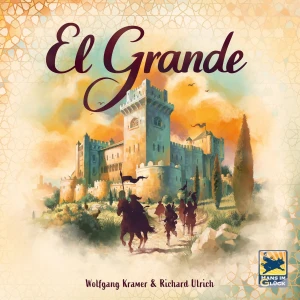
El Grande is a medium-weight area control board game from 1995 by Wolfgang Kramer and Richard Ulrich. The Second Edition I played is the newer 2023 version, with updated visuals and components. Players are nobles in 15th-century Spain trying to gain influence across the map by placing caballeros, which are basically your little knight pieces.
- Players use Power cards numbered 1 to 13 to determine turn order and how many caballeros they bring into their court.
- Higher Power cards act earlier, but usually give you fewer caballeros to work with.
- On your turn, you draft an Action card, use its special action, and place caballeros into regions adjacent to the King’s region or into the Castillo.
- The King’s region is locked. You can’t add pieces there, remove pieces there, or mess with it while the King is there.
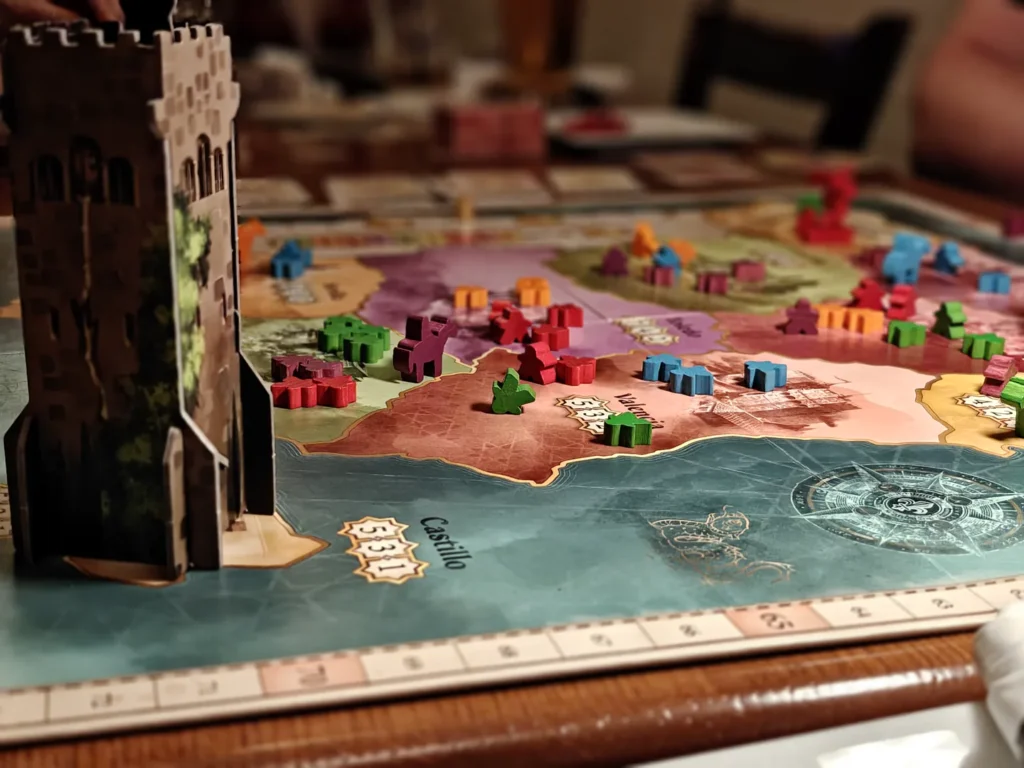
- The Castillo is a 3D tower where players secretly drop caballeros, then later reveal and send them to chosen regions during scoring.
- The game lasts nine rounds, with major scoring after rounds 3, 6, and 9.
- Most of the game comes down to majority scoring, tempo, timing, reading people, and taking small point leads over several rounds.
The basic rules are surprisingly easy. I think you could teach someone who likes Risk how El Grande works, and they’d probably understand the shape of it within the first couple turns. That doesn’t mean they’d be good at it, but they would know what they’re trying to do. That is a big part of why this works.
What I like about El Grande
The rules are simple, but the decisions are tense
I tend to like heavy games, but El Grande is a good reminder that depth doesn’t always need more rules, more tokens, or 40 little subsystems to keep a game fresh. Sort of like chess, this is a simple ruleset, and the game still feels tense because every decision has a cost.
The Power card system is the best example. If you bid high, you get to act early and draft one of the better action cards first. But you usually bring fewer caballeros (your little colored meeples) into your court. If you bid low, you get more bodies to work with, but you probably (but not always) picked later and watch other people take the thing you wanted. Since you can only play each Power card once until you get them back (maybe), everyone gets pulled through this little rhythm where you can’t always be first and you can’t always be rich in pieces.
That one system does a ton of work. You get turn order, resource tempo, card memory, and future planning all tied into one decision. It’s clean. I like clean. And it’s also all, for the most part, known information. You get to see what people do ahead of you and decide.
It feels modern without feeling overbuilt
El Grande is from 1995, but the game didn’t feel dusty and old to me. (I did play the newer edition copy, that might have helped…) The setup was fast, the explanation was fast, and there were only one or two rules that felt like they needed an extra second to sink in. Did I mention things went fast?
As mentioned… the second edition also looked really nice on the table. I don’t own it, so I can’t speak to living with the components long term, but the version I played was pretty. For an older design that just got reprinted in recent years, that helps. It looked like a game people would actually want to sit down and play now, and while I am perfectly fine playing older games… not every one is.
And honestly, I expected it to feel more old. It didn’t. It felt like a modern area control game that got there by cutting away noise instead of adding more stuff.
The King is an unexpected but great little weapon
Unlike the robber in games like Catan… The King is probably my favorite part of the game. Moving the King isn’t just a small positional thing. It changes where people can place pieces, it protects whatever is already inside that region, and it can set up a two-point bonus if you win the King’s region during scoring which is harder than it sounds (and not always worth the effort).
That gives the game a nice offensive and defensive shape. You can use the King to protect your lead in an area, block other people from messing with it, or set up a scoring opportunity. Other players obviously want to do the same thing, so there is this constant push and pull around where the King goes and when someone is going to fight over that card.
I also like that the King can make a plan feel protected. In a lot of area control games, I get frustrated because I try to set something up and then everyone immediately smashes it apart. I suppose I am too, part of that smashing for other players, but IT ONLY FEELS BAD WHEN IT HAPPENS TO ME (I’m kidding of course). In El Grande, the King’s region being off limits gives you a little shelter. Not complete safety, as there are some cards that can move the King again (something I didn’t know in my first playthrough…) but enough that planning doesn’t feel pointless.
The Castillo is a gimmick, but a good one
The Castillo is the big 3D tower that sits over in the corner and yes, it is kind of a gimmick. You drop caballeros into it, they get hidden, and everyone has to either remember what’s in there or make a good guess. During major scoring, players secretly choose where their Castillo pieces will go, then the tower gets revealed, scored, and those pieces move out.
In my game, it was very impactful. The Castillo reveal had a lot of fun table tension because even if you think you know how many pieces are in there, you don’t know where people are sending them. I kept thinking I was choosing places nobody else would want, then of course other people had the same idea. We had a few great “oh man, you picked that too?” moments where regions went from mostly empty to 20+ meeples in them.
That said, I can also see the downside. If your group is very good at tracking pieces, the hidden part can become a known quantity. Someone could just count everything on the board and figure out what is probably in the tower. So I think the Castillo depends a lot on the table. With the right group, it creates bluffing and psychological warfare. With a more practiced group, maybe it becomes lighter than it first appears or too much of a disadvantage if you have players NOT tracking it. It’s not trivial but it’s also kind of trivial.
It is a friendlier knife fight
First, I’ll say I am not the first to call it a friendly knife fight. In fact, I’ve had the game described to me that way once in passing. But it’s true! El Grande still has take-that stuff you may hate (I often am not a total fan of them). People can and will hurt you. If you’re in the lead, smart players should probably start chopping at you while trying to score their own points.
But this felt like one of the less personally annoying versions of that kind of conflict. You’re usually not just killing troops because you hate someone or out of revenge (there can be a tiny bit of this but it’s not the focus). The action cards come out, someone has to take them, and sometimes the correct play is to remove or move pieces anyway. That makes the conflict feel more like the system pushing players into hard choices instead of one person randomly deciding your turn doesn’t get to exist or that all your hard work needs to be erased (that is of course, you are really in the lead in the last few rounds… like I was…)
That might sound like a small distinction, but for me it matters a lot. This is still a knife fight, but it’s a cleaner one. I think that makes El Grande a pretty good introduction to area control for people who don’t normally love the genre.
It rewards the smaller details in point scoring
One thing I noticed is that the scoring often feels like small gains over many rounds. You might score 18, someone else scores 14, someone else scores 12. There are winners and losers in each scoring moment, but it isn’t always one giant swing that decides the whole game. Those tiny 1 point victories you get add up and I honestly think the people at my table overlooked them a bit.
That makes the game feel like you’re building a lead through lots of little good choices, some good timing, and some luck based on what cards were available. It doesn’t feel like a Euro where you commit to one giant engine and ride it for the whole game as a ride or die type of strategy. In my game, I felt like every turn I thought… hmm… I’m going to thing A, then the board pushed me into doing something else immediately.
I liked that here. Sometimes being forced to change plans is annoying. In El Grande, it mostly felt like the point.
What I don’t like about El Grande
Kingmaking is still real
El Grande doesn’t magically solve my biggest area control problems. Kingmaking can absolutely happen here. If you’re not winning, you still have agency, and that means you can start making moves that shape who does win if you are inclined to do so. This is a mixed bag for me and depends mostly on the players and how they handle it… but… it exists here.
There is also a runaway possibility if the table doesn’t pay attention. If someone is in the lead and everyone just keeps playing their own game, that player can keep banking points until catching up gets ugly. The game expects people to recognize the leader and hit them, at least, I think that’s the case. If your group doesn’t do that, or if only one person does while everyone else benefits, the game can get weird.
So yes, this is friendlier than a lot of area control games for me, but it still asks the table to manage the leader. Some people love that. I don’t always. My table didn’t really discuss open strategy, so I wonder if there are groups out there that do.
The diplomacy could swing the whole experience
In the game I played, everyone mostly played their own game. There was interaction, obviously, but it wasn’t a huge table-talk diplomacy festival. I think that helped me enjoy it a bit more… mostly because I feel like I’m the evil person once I start suggesting things to others. I’ve won games like that in the past, and sometimes it’s fun, but I do feel bad if I take advantage of someone inside the game (after the game).
I can easily imagine a different group making El Grande feel very different. If you have players constantly trying to convince each other to attack, block, or kingmake, this could become much more social than I personally want. That can be a plus if you like that kind stuff at the table. It can also be a problem if you don’t.
Analysis paralysis is a real possibility
The bidding phase can be hard. You have to commit to a Power card before you fully know how the round is going to shake out, and if you aren’t sure what you want, that decision can feel weirdly stressful. It’s pretty easy when you go first or go last, especially last, but anywhere in between it can take thought.
There were moments where I picked a card, watched the round develop, and thought, “oh, I picked the wrong thing.” When it works out, it feels great. When it doesn’t, you can feel like you lost the round before you even got to take your turn.
That is a double-edged sword. The same tension that makes the system satisfying can also slow the game down if people need to calculate everything.
Card knowledge probably matters a lot more than you’d think
I didn’t know the cards at all, so I had no idea what to expect. That made the game exciting, but also made some decisions feel like guesses. I had no clue the King could move again after I bid my 13 card to secure it. Oops. I had no idea how many different score region cards there were. Or you could look into the Castillo or lose meeples. The list goes on.
Once you know the deck, I can see the game opening up in a different way. You can start planning around which scoring cards might appear, which cards can move the King, and when to contest certain regions. That is probably where a lot of the competitive depth comes from.
I don’t think that is completely bad… there are tournaments for this game for a reason. But it does mean a first play is probably not showing you the whole game. I won my first play, and I still felt like I was mostly surfing the table state more than executing some brilliant master plan.
Long-term planning is impossible
I sort of touched on this but this is definitely not a game where you can have long-term goals. I do like long-term goals in games with a certain amount of fluidity, but I don’t think you could be successful at all trying to plan even two rounds ahead.
Final Thoughts about El Grande
I can see why El Grande has the reputation it has. It is one of those granddaddy games I somehow hadn’t played until someone brought it to a meetup, and I had a lot of fun with it.
Would it become one of my favorite games ever? Probably not. Area control still isn’t my favorite genre, and El Grande still has kingmaking, leader-bashing, diplomacy issues, and potential analysis paralysis. Those aren’t small things for me.
But I would play it again. I might even consider owning it, because it feels like a friendly area control game to have around. I also kind of want to look into what the Big Box adds, though the newer Second Edition already seems like the cleaner version to actually put on the table. I’ve read that no one plays with the expansions, but I’m still curious about them.
After one play, I don’t think I’m going to discover some broken strategy that makes me hate it. It feels like a known quantity in a good way. Maybe if I played it ten more times, my opinion would go up or down a little, but I doubt it would completely change. This is a very well designed game that probably won’t be perfect for me, but I get why people love it.
Just my opinion, but if someone wanted to show me why area control can work without burying me in rules or making every attack feel personal, El Grande is probably one of the better places to start..











Disagree With Me Here
Discussion and disagreement are welcome here — that's what makes talking about games fun. Just keep it kind. Attacks on people, not ideas, will be removed.