


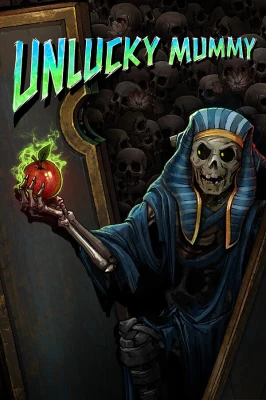


Unlucky Mummy Review: A Great Hook That Gets Lost in the Odds
A Unlucky Mummy review by wakasm
I am pretty much always interested when an incremental game has one clean, slightly absurd idea. That is the kind of thing that hooks me with these games. I don’t always need a giant system at first although those can be welcome too. Sometimes I just need one button, one weird premise, and one question that makes me go, alright, I need to see how this actually plays out.
Unlucky Mummy has that. It is an incremental clicker about opening a cursed sarcophagus over and over again, trying to pull relics out of it before the odds eat everything you just did. I really like the concept. Anything related to odds usually has my attention. I don’t know that it fully nails the execution enough to become one of my favorite incrementals, but as a tiny cheap game (I purchased it for $2.59) built around luck, probability, Egyptian mythology, and this almost slot-machine feeling without the money payouts… I was ok jumping in and trying it.
What is Unlucky Mummy?
Unlucky Mummy is an incremental clicker from Karaclan where you open a cursed sarcophagus and try to find relics tied to Egyptian gods.
- You start with a 25% chance of finding a relic and a 75% chance of finding nothing.
- There are 12 relics tied to Amun, Osiris, Isis, Seth, Ra, Anubis, Hathor, Sekhmet, Horus, Thoth, Bastet, and Sobek.
- If you find a relic, you earn golden scarabs, which are used to upgrade relic values, opening speed, and your chance of success.
- If the sarcophagus is empty, your current streak resets, but the relics you have discovered stay known.
- The machine pulls known relics first, then searches for new ones once the known set has appeared again.
- The first big goal is to find 12 relics in a row and resurrect the mummy.
- The twist is that this does not really end the game. Act 2 asks you to get 24 successful openings in a row. (Do the odds on that)
- There are six endings, and each ending gives you a permanent Glyph that changes future runs.
At 25%, the odds of getting 12 relics in a row are 1 in 16,777,216. The later 24-relic version is about 1 in 281 trillion. The game knows this is ridiculous. The narrator knows this is ridiculous. Part of the joke is that you keep doing it anyway.
What I like about Unlucky Mummy
The hook is simple in the way good incrementals can be simple
The basic idea is very easy to understand: open the sarcophagus, hope something is inside, upgrade your odds, repeat. But the way it handles discovered relics gives it just enough structure that it is not only a blind button press. If I find Isis, then fail, Isis is still known, so the next time the sarcophagus finds a relic it will bring Isis back first before trying to push farther. That makes progress feel weirdly permanent and temporary at the same time, which fits the whole quantum mummy thing better than I expected. You are not just trying to get lucky once. You have to do it 12 times in a row, but each time you do it, you make money faster.
I also just like games that mess with randomization as the point. This almost feels like a game where someone said, what if the whole thing was flipping a coin until you got an impossible streak, except the game starts at worse-than-coin-flip odds and then gives you tools to drag the math back toward sanity. It is not a deep strategic game, and I don’t think it is trying to be. It is a push-your-luck incremental where the entire premise is, do you want to press the button again even though you probably should not?
The presentation does a lot of work
For a game that is basically one screen the whole time, I think Unlucky Mummy looks really nice. The art, music, animations, sarcophagus, relic board, scarab jar, and all the little screen effects make it feel much more polished than the core mechanic probably sounds on paper. When you start revealing new relics in a longer streak, the game adds these little hesitations and visual beats that make the moment feel good. It is not just a number going up. It gives the opening animation this little pause where you can feel yourself waiting for the universe to betray you.
The narrator is probably the best part of the aesthetic side for me, outside of the art itself. He explains Egyptian gods, talks about Schrodinger-style superposition, makes fun of you for opening the door hundreds or thousands of times, and generally gives the game way more personality than it would have had as a silent clicker. Some of the lines are just funny in context, like when he eventually tells you, “You have no real chance of winning.” Later he basically decides that maybe the mummy and tomb are not cursed, and that “it is you who the curse is.” That is the exact kind of petty cosmic narration this game needs.
And not everything is a joke. You get a lot of weird facts about the gods. Like “Ra rode a solar boat across the sky, controlling the cycles of day and the night.” or “Seth is the most controversial of the gods, the personification of chaos and sandstorms.” I’m not sure how factual they are, but I felt like I walked away with more of an understanding of this culture than I should have for such a game.
The Glyphs make repeat runs move faster
Once you finish a run, you get a New Game Plus style Glyph that permanently changes future playthroughs. I like this part in theory, because it gives a very short game a reason to loop back around without pretending it is suddenly some huge forever game. Some of the Glyphs are simple but meaningful, like earning scarabs passively, making the first relic max level and always first, or making gods more likely to form combos. The strongest one I saw early was the perfect mechanism, where the sarcophagus can only be empty once in a row. That basically means an empty result guarantees the next open will hit, which makes the game feel massively faster.
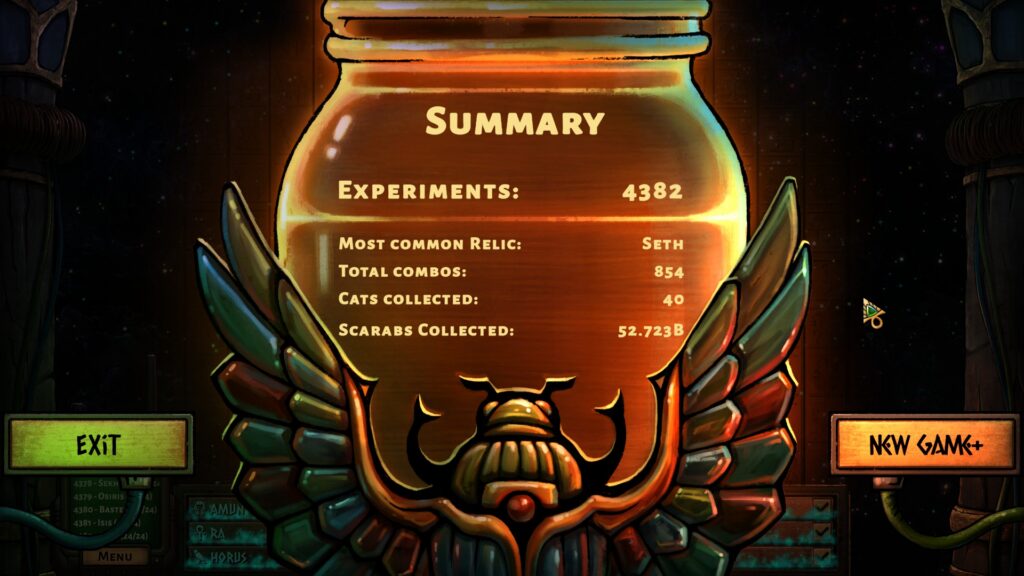
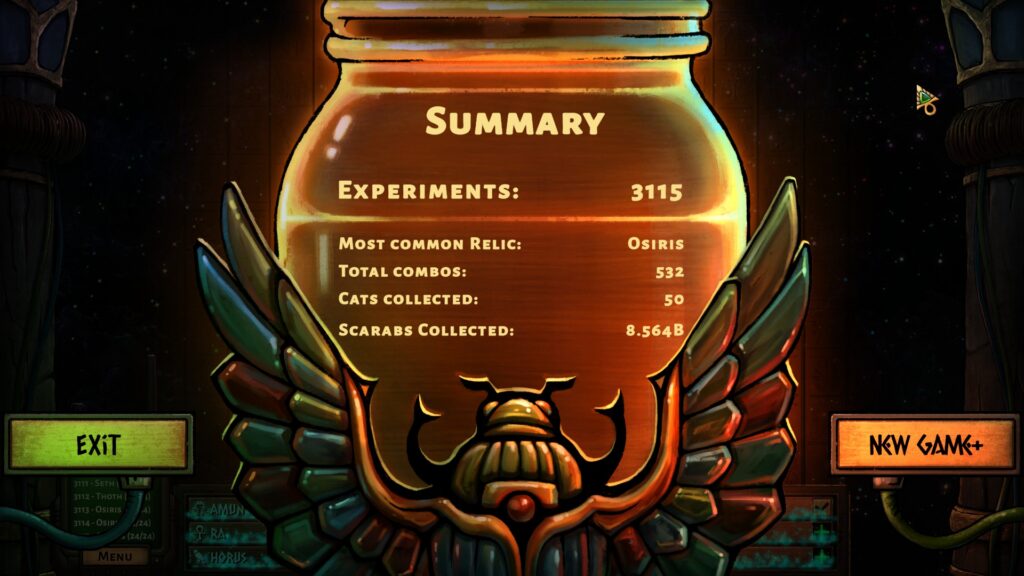
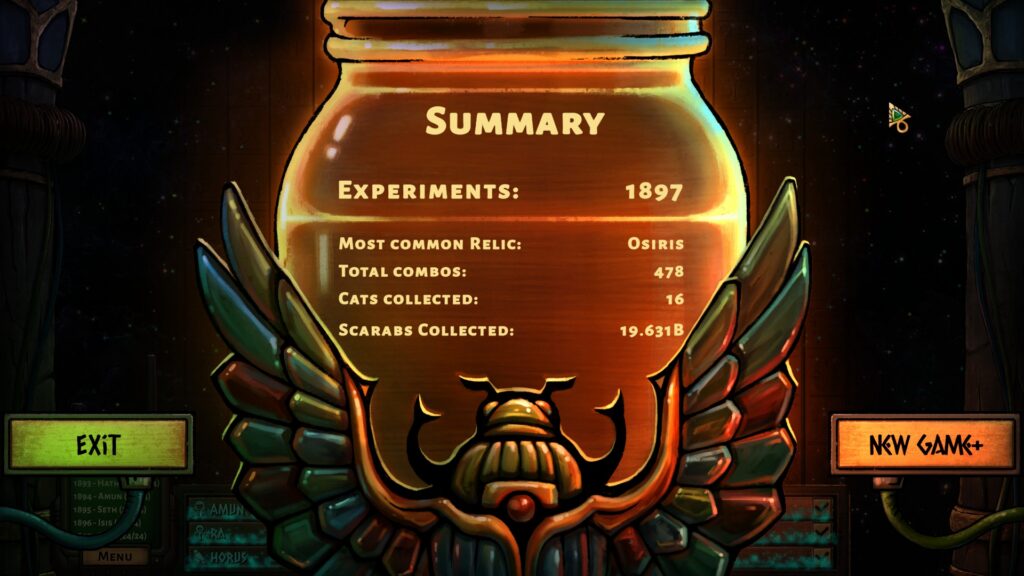
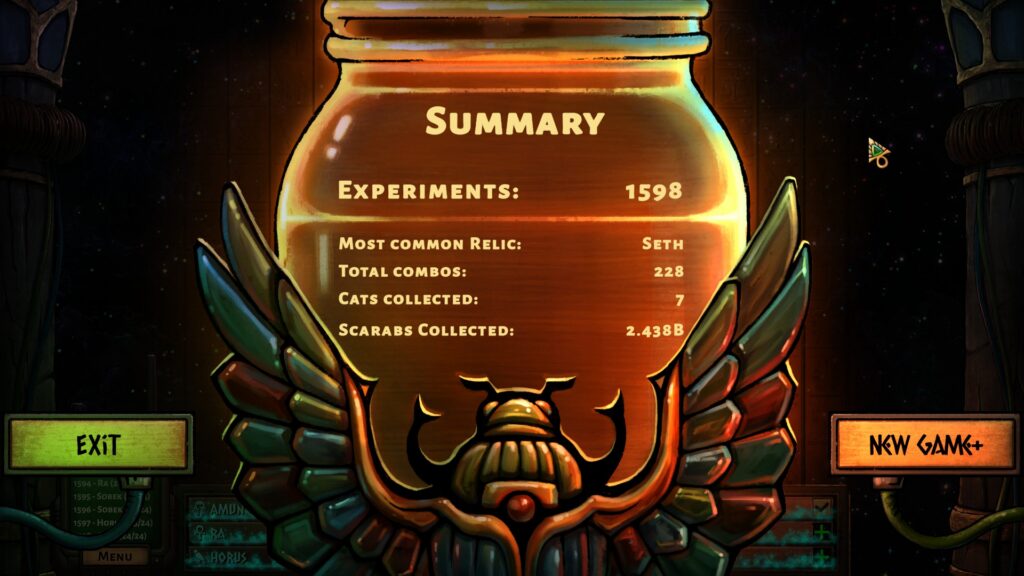
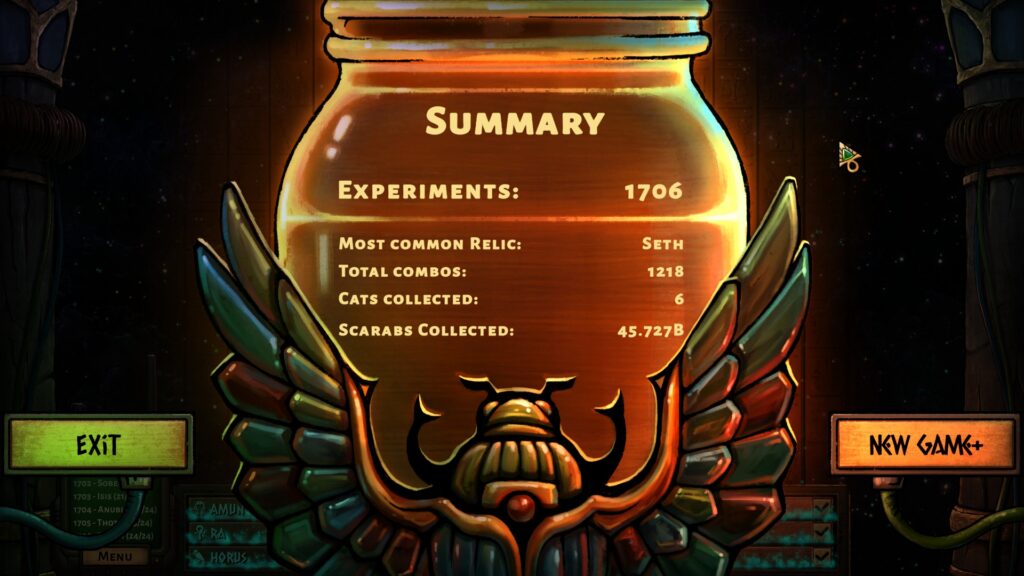
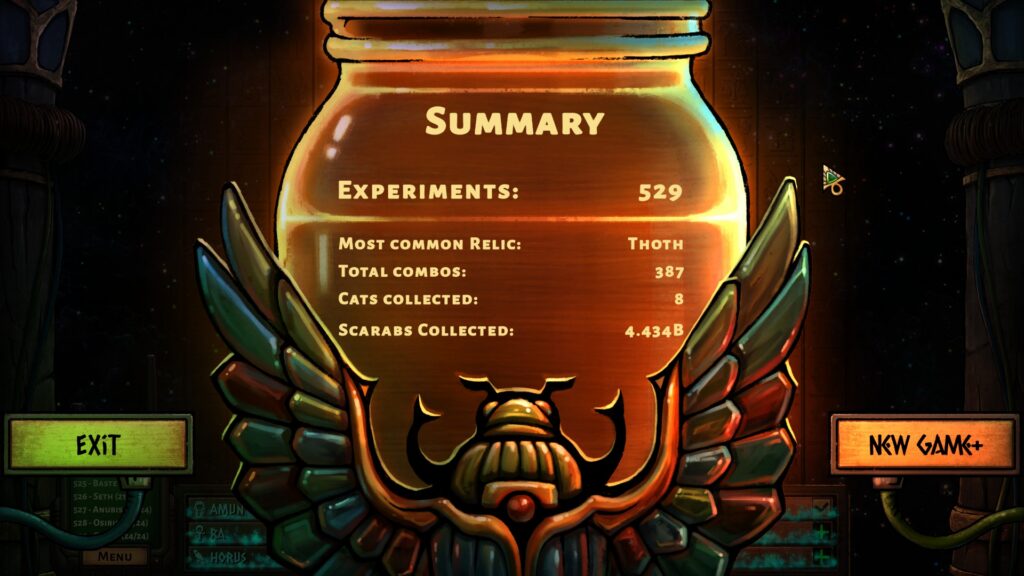
By the end, my first clear was somewhere around 4,500 opens and took about two and a half to three hours, though I was tabbing out a decent amount. Later runs were closer to 1,200 opens once the Glyphs started stacking. That progression does work. You can feel the game getting faster, and the idea that each ending leaves behind a permanent power is a good fit for this kind of short incremental experiment.
It is cheap, short, and knows what it is
This is also one of those cases where price matters. Unlucky Mummy is around three dollars on Steam, and there is an Itch.io version that lets you get a pretty good sense of the hook. For me, any incremental under five bucks is usually worth at least exploring if the idea looks interesting, and this one has a stronger theme than a lot of tiny number-go-up games. I don’t want to oversell it, but I also do not mind a game being small when it is priced and framed like a small game.
It is the kind of thing I can see myself checking back in on if it grows. It has a very specific concept, the art direction is strong, and it feels like there is room for more mechanisms or more weird probability jokes if the developer keeps adding to it. I don’t know exactly what I would add, which is always a weird place to be with criticism, but I am curious what this could become.
What I don’t like about Unlucky Mummy
The math and pacing do not always feel right
Where the game breaks down for me is the math. I understand that it is using true randomness, or at least trying to preserve that feeling, and that means long unlucky strings can happen. That is the game. But there are stretches where the game just falls into dead air. You open it, nothing. Open it, nothing. Open it, nothing. Maybe a relic, then nothing. When you are in the early game and upgrades are flowing, that is fine. Later, when you need another big push and the costs are higher, it can feel like you are waiting for luck more than playing.
That is hard to criticize cleanly because, again, the entire game is about luck. If you sand off the randomness too much, you probably kill the point of the game. But the pacing still has these dead periods where it feels less like a clever incremental and more like a slot machine with no payout. You are not losing money, thankfully, but you are still watching the same action whiff over and over again until the numbers decide it is time for you to progress.
Upgrading relics feels useful, but maybe not useful enough
The relic upgrades were the part where I kept feeling like something was a little off. You can upgrade each god’s relic value, and the values double as you invest in them, but because streak multipliers and combos can scale rewards so hard, individual upgrades did not always feel as meaningful as I expected. I had some gods upgraded all the way to maximum, and they still did not seem to massively outscore the other relics on their own.
I might not fully understand the math, because the reward formula seems to involve the relic level, where it appears in the streak, whether it lands in a combo, and probably some other scaling I was not watching closely. But in practice, getting lucky and hitting a long streak often felt more important than carefully upgrading specific gods. If you get six relics in a row early, you can suddenly buy a lot. If you do not, you are just stuck waiting. That can make the upgrade economy feel a little flatter than it should.
I could be wrong, but the optimal strategy is to just upgrade one god fully in each column/row and then they will artificially increase the bonus for everything.
The endings are more different narratively than mechanically
There are six endings, and each one gives you a Glyph, so I do think they matter if you like the whole new game+ loop. I was just expecting the endings themselves to be more drastically different… maybe different final enemies, or something more visually different. They are more like different narrative layers or different branches of the mummy story, which is fine, but I think part of me expected bigger differences after repeating the full loop several times.
The Glyph rewards are the more important part. The final one I unlocked makes the clickable ghost cat give 10x rewards. The ghost cat is a thing I forgot to even mention at first, but it shows up sometimes when you get nothing and gives you a reward if you click it. Since that final Glyph was the last win I needed for 100%, I did not really get to see how impactful it was. The cat only shows up sometimes, and it only seemed to scale into something useful when I was already at higher open counts, so that one is hard for me to judge.
I got progressively faster with most of them (my 5th game was somehow slightly slower than my 4th, but I had some really bad luck during it).
It is not really an idle game
This is worth saying clearly because I think it matters for expectations: Unlucky Mummy is an incremental clicker, not really an idle game. It is inspired by incremental and idle games, and later Glyphs can make it idle a little bit, especially with passive scarabs, but the core game is you opening the sarcophagus again and again. You could probably use a clicker if you really wanted to save your hand, and later powers reduce some of the friction, but if someone goes in expecting a mostly idle experience, I think they might bounce off it.
It is also short. I think you could probably do everything in six or seven hours, maybe faster if you are dedicated and your luck is decent. That is not automatically a negative for me, especially at the price, but some people may not like that. This is a tiny focused experiment more than a long-term incremental obsession. I alt-tabbed out a lot to do other things.
You pretty much click one button
This is probably going to be the biggest critism. You literally are just clicking one button. It’s really not that much different than being in a casino playing slots and hitting max bet over and over again. The strategic depth really isn’t there other than maybe to selectively upgrade the gods and once you unlock certain glyphs waiting things out to get free upgrades.
Final Thoughts about Unlucky Mummy
I liked Unlucky Mummy. I don’t think it is the greatest incremental I have played, and I don’t think it is the worst. It has a really good concept, nice graphics, a strong narrator, and a funny little relationship with probability where the game is basically telling you that you are doomed while still giving you just enough upgrades to keep going. That part works.
The part that holds it back is that the math does not always feel satisfying as a game. True randomness is funny, but true randomness can also be boring when you are stuck in a long dead stretch. The upgrades help, the Glyphs help, and the later runs absolutely get faster, but there are still too many moments where I felt like I was not making an interesting decision. I was just waiting for the sarcophagus to stop being rude.
Still, for around three bucks, I think this is a decent little incremental if you like this kind of thing. I am into these games, so I did not mind spending the time with it, 100%ing it, and seeing all six endings. I mostly just wish the economy had a little more snap to it, or that maxing gods felt more important, or that the dead zones had something else happening in them. Maybe that comes later. I don’t know. This feels like the kind of small game I might come back and revise over time if it grows.
Check out my full game rankings and eventually I should have a filter for Idle + Incremental games. You can see where this ends up over time. If updates make this more fun, and I remember to check back, I’ll write some thoughts here!
My Final Session Progression In 6 Screenshots

























Disagree With Me Here
Discussion and disagreement are welcome here — that's what makes talking about games fun. Just keep it kind. Attacks on people, not ideas, will be removed.