




Dungeon Pages: Overland Adventures Review - A Better Version of Dungeon Pages?
An Early Impressions review of Dungeon Pages: Overland Adventures by wakasm — based on 2 plays
When I first got into Dungeon Pages, one of the biggest appeals was just how minimalist the game was. It’s one sheet of paper, a few dice, has clean iconography… and somehow it still manages to feel like a real abstract solo adventure game instead of just a throwaway puzzle. The premise is a little weird, you are putting sequential numbers from a start to and exit… but it always scratched that same part of my brain that Sudoku and roll-and-writes do, where it feels kind of relaxing on the surface, but the luck of the dice make it more challenging (or unfair at times) to give enough mix between the two.
So with Overland Adventures, the real question for me wasn’t whether it was “good,” because I already liked the core system. It was whether this was just more Dungeon Pages… or whether it actually improved it. And after playing it, I kind of think this is probably the better version of the formula. Not in a way where the original suddenly becomes obsolete, but definitely in a way where it feels like the designers understood what was already working and found a few smart ways to make it more interesting. It’s still a light imperfect game, but I enjoy the small improvements they made.
What is Dungeon Pages: Overland Adventures?
- A solo print-and-play dice puzzle / roll-and-write dungeon crawler played on a single sheet
- You roll good and evil dice, place values into the map, defeat monsters, collect loot, and try to escape with a sequential path
- Overland Adventures adds elemental hero powers, merchants, side quests, new terrain, and a little more structure than the base game
If you’ve never played Dungeon Pages, here is the core loop. On your turn, you roll your good dice and evil dice, check whether wandering monsters or active enemies are going to hit you, and then use all of your dice, including the evil ones, to write values into the map. You’re trying to defeat monsters by placing values next to them that meet or beat their defense, collect loot by creating adjacent doubles, and build a path from the entrance to the exit. If you make that path sequential, meaning the numbers stay equal to, one higher than, or one lower than the previous number, you escape and gain XP. That XP is then used to level up your hero, unlocking more good dice, more survivability, and stronger abilities over time. It’s still kind of amazing how much actual game is packed into one page. It’s still a very casual game don’t get me wrong, but it’s still a lot.
Overland Adventures keeps all of that intact, but layers in a few new ideas. The biggest one is probably the elemental hero powers, which now let you circle certain values you’ve already marked in your current map to trigger effects. That’s a smart little shift because it makes your board state feel more connected to your character instead of just being a place where numbers go. On top of that, there are merchants that let you aim for more specific rewards vs being forced into what loot is exactly on the map. There are side quests that add extra objectives you need to complete to fully win, and new terrain like bushes, running water, and landmarks that tweak how the puzzle feels without changing the identity of the system.
What I like about Dungeon Pages: Overland Adventures
It Feels Like a Better Version of the Original
The biggest thing Overland Adventures has going for it is that it really does feel like a more refined version of Dungeon Pages instead of just a pile of extra content. This feels like the version where the designers actually learned from making the original and came back with a clearer understanding of what made it work. The game is a little more complex, sure, but not in a bloated or annoying way which is a great evolution for a semi-sequel.
The Hero Powers Are More Flexible and More Fun
Probably my favorite actual gameplay change is the new hero ability system. In Overland Adventures, the elemental powers are tied to numbers you’ve already written into the dungeon, and I think that’s just way more interesting than a lot of “limited use special ability” systems tend to be. Instead of just looking at your character sheet and asking whether now is the right time to spend a power, you’re also looking at the board and asking what values you’ve already created and whether you want to cash one of those in. It also means you get to actually use the powers more compared to the limited use items.
And for a game this small, that kind of thing matters a lot. It gives the heroes more personality and more flexibility without making them much harder to understand.
The Merchant and Side Quests Add Good Pressure

I also think the merchant is a really smart addition because it takes something Dungeon Pages was already doing, collecting rewards through adjacent matching numbers, and gives it a little more intentionality. Instead of just taking whatever reward falls into your lap, you can now actually shape some of your priorities around what kind of help you want. Do you need a health potion or something else? The only negative I have for the merchant system is that you can’t take the same thing multiple times… I sort of wish you could do that.
The side quests also do a nice job of pushing the game into slightly more interesting territory. I think they’re cool because they add a little more pressure and give you something else to think about beyond just surviving and making a clean path to the exit. Now you’re also trying to hit extra objectives and manage the run in a more deliberate way. But be warned, some quests don’t feel great but the core idea is interesting.
The Mix-and-Match Replayability Is Genuinely Cool
One of the cooler things about the original Dungeon Pages, and Overland Adventures too, is that you can literally cut the sheets in half and mix the heroes with different dungeons, which adds a lot more replayability than you’d expect from such a small print-and-play game.
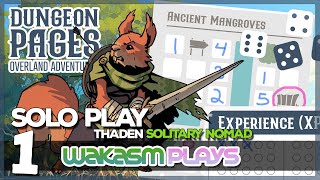
If randomized variety is your thing, this has that. Want to play as Thaden, the squirrel-like Solitary Nomad, through Northern Mangrove? Or use Deyli, the bird-like Gifted Sharpshooter, in Emerald Palace? Or take Solzo, the mouse-like Devout Druid, into The Brothers Canals? You can do all of that, and it gives the game a nice modular feel that helps keep the system fresh longer than it probably should.
It’s not perfect balance wise, but it does give a lot more permutations if you want more. (me personally will probably never play through hem all, but I’m sure someone out there has or will!)
The Rules Are Cleaner Than They Have Any Right to Be
One thing I do think is worth calling out is just how streamlined the whole package feels for what it’s doing. Overland Adventures adds new terrain, new loot behavior, merchant choices, side quests, and more nuanced hero abilities, and somehow it still doesn’t feel like the rules got bloated or fiddly. The rulebook is still somehow only 5-6 pages. I still find weird edge cases that need FAQ-like explanation on the pnparcade discord but the rulebook is very intentionally written.
What I don’t like about Dungeon Pages: Overland Adventures
It Definitely De-Chills the Original a Little
If there’s one clear tradeoff with Overland Adventures, it’s that I do think it makes Dungeon Pages a little less chill. The original had a very nice “light solo puzzle” feel to it, even when things were going badly. Here, because there are more systems layered on top, more things to keep track of, and more objectives to care about, it feels a little less breezy. It’s still a very light game, I don’t want to misrepresent the weight, but it is heavier than the original.
It Still Has That “Samey Over Time” Ceiling
As much as I like the system, I still think Dungeon Pages as a whole has a natural ceiling to how fresh it can feel over time. And Overland Adventures doesn’t completely escape that. The core loop is still very recognizably Dungeon Pages. You’re rolling dice, placing numbers, trying to path out efficiently, and hoping your rolls aren’t unlucky enough that you lose.
The Dice Can Still Be Mean
The hero powers can help with this if you can forcefully stack the correct values to manipulate the the dice, but this is also still a pretty luck-driven game. It’s possible to lose early due to not fault of your own and/or just never get the values your character wants.
I don’t think that ruins the game because it’s short, cheap, easy to reset, and not the kind of thing that wastes your entire night when it goes badly. But it is still part of the package.
Final Thoughts about Dungeon Pages: Overland Adventures

Overall, I think Dungeon Pages: Overland Adventures is probably just a better evolution of the original formula. It still has the same clever little one-page puzzle engine at its core, but the new hero powers, merchants, side quests, and terrain twists make it feel a little more developed and a little more satisfying to chew on. I don’t think it radically transforms Dungeon Pages into something else, and I don’t think it needs to. It just feels like a smarter, slightly more advanced version of something that was already pretty good.
I’m still not fully sure whether I like this or Underboss better yet, and I’d want more plays before I totally lock that in, but I do think this is probably one of the strongest versions of the system so far. If you already like Dungeon Pages and want the version that feels a little more refined and a little more game-y, this is probably the one I’d point to first. If you want the absolute chillest version of the concept, the original might still have a little bit of an edge. But overall… yeah, I think this is a very good little evolution of the formula.









Disagree With Me Here
Discussion and disagreement are welcome here — that's what makes talking about games fun. Just keep it kind. Attacks on people, not ideas, will be removed.