







Legacy of Yu Review: Legacy Campaigns Are Fun… To a Point
A Legacy of Yu review by wakasm
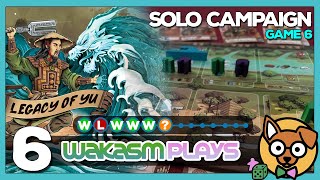
Legacy games are always interesting to me… I like the idea of a game evolving over time, unlocking things, changing systems, giving you that sense of progression where each play builds on the last. But there’s always this question sitting in the back of my mind when I start one… is the actual gameplay loop strong enough to carry that experience, or am I just chasing the next unlock to stay engaged? Legacy of Yu kind of lands right in that space for me. I’m about six games into the campaign right now, sitting at five wins and one loss, and I feel like I’ve seen enough of the system to understand both what it does really well and where it starts to wear a little thin.
So what exactly is Legacy of Yu?
What is Legacy of Yu?
- Solo-only campaign game set around controlling floods in ancient China
- Play until you reach 7 wins or 7 losses
- Card-driven worker system with resource generation
- Build an engine through farms, huts, and outposts
- Flood advances as you cycle through your deck
- Multiple loss conditions including flood, barbarians, and objectives
- Legacy-style progression with unlocks that adjust difficulty
- Resettable campaign system
What I like about Legacy of Yu
Engine building that actually feels good early
The early game flow feels really good once your engine starts to come together, and this is probably where the game is at its strongest. You’re building up farms, outposts, huts, and each piece starts feeding into the next turn in a way that feels very tangible. There’s a rhythm that develops where you’re collecting resources, planning a couple turns ahead, and you can feel your position getting stronger as you go. It’s not abstract engine building where you kind of assume you’re improving… you actually see it play out turn by turn. You start to hit resource limits and have to really start considering many of the trade ratios that exists in there game. Do you take a small risk to accelerate your engine, or do you play it safe and keep things under control by trying to remove an extra barbarian? That tension works really well early on and is easily the most engaging part of the experience.
Clean iconography that gets out of the way
The iconography is really clean, and this is one of those games where once you understand what everything means, the board basically runs itself. I only had to double check a few things that came up from the campaign, but for the most part everything is intuitive and readable. After a couple plays, you’re not thinking about the rules anymore, you’re just playing the game, especially if you have the turn order table out. It feels like the system gets out of your way pretty quickly, which helps the flow a lot.
Early tension between growth and survival
There’s a really solid tension early in the game between building your engine and dealing with barbarians, and this creates some meaningful decisions. You’re constantly trading short term safety for long term growth, and you can’t really ignore either side of that equation. Some of the barbarians that show up later can be pretty punishing too (although the order of which they appear I think can vary based on the legacy system), so you’re not just casually brushing them aside. Do you recruit more workers to improve your future turns, or do you spend those resources now to deal with an immediate threat? That constant balancing act gives the early game a lot of life.
Killing a barbarian gives you a reward, but letting them sit there drains your resources. It’s almost like a weird “Whack-a-Mole” system.
Smart campaign system that always moves forward
The legacy system here is actually pretty clever. When you win, the game gets harder, and when you lose, the game gets easier, so the campaign is always pushing forward no matter what happens. You’re never stuck grinding in place, and you always know there’s an endpoint, which I appreciate in a campaign game. It’s also resettable, which is nice, even if that makes it feel a little less like a true legacy experience. There are no stickers nor are there ripping up cards. Still, from a design standpoint, it does a really good job of keeping things moving. It’s also very fast to setup and teardown.
Unlocks that create curiosity
There are definitely unlocks in this game that push things in different directions, and you’re (likely) not going to see everything in a single campaign unless you somehow win and lose the same number of times… I unlocked something pretty early that felt very strong, maybe a little too strong, and it immediately made me curious about what I didn’t get to see. That sense of curiosity is a good thing, even if it comes with some balance concerns. It’s one of the few elements that makes you think about playing again, even if the core loop doesn’t fully support that on its own.
A concept that feels like it should be great
I really like the core concept of what this game is trying to do. Managing an engine while dealing with a constantly advancing external threat is a strong foundation, and it feels like something that could have been pushed a little further into something great. I don’t know exactly what it needs to get there, but there’s definitely something here that works. It just never fully evolves beyond that initial idea. It’s definitely not perfect, but it’s a great start.
What I don’t like about Legacy of Yu
Starts to feel samey pretty quickly
After about six plays, or whenever you start to notice certain strategies… the game starts to feel a bit repetitive, and this is probably my biggest issue with it. The overall rhythm settles in really fast. You build your engine, you stall the flood, and then you repeat that process over and over. There were actually moments where I made the game harder for myself on purpose just to push things forward because I didn’t feel like playing out every round optimally. Not because I was going to lose, but because I already knew how things were going to play out. That’s usually not a great sign for long term engagement.
It also feels like stall tactics really give you an advantage in this game.
Balance can swing too far in your favor
Once you find a strong combination or unlock the right power, the balance can tip pretty heavily in your favor. After my one loss, I unlocked something that made the next five games feel almost automatic, especially if I slowed things down and played carefully. At that point, it kind of becomes a question of how you want to approach the game. Do you push forward and take risks to make it more interesting, or do you just play it out and secure the win? A lot of the time, it feels like the safer option is just correct, and that takes away some of the tension.
Late game turns can drag
When you do get ahead, turns can start to drag, and this ties into the balance issue a bit. The difficulty doesn’t really scale dynamically during a game, it mostly changes when the flood advances, so you end up in these stretches where you’re just cycling through actions and waiting for something to happen. You’re building, collecting, optimizing, but not really making meaningful decisions anymore. It still feels tense on the surface, but if you actually broke it down, you’re mostly just executing a plan you already know is going to work.
Story exists but doesn’t do much
The story elements are fine, but they’re not especially engaging. They mostly exist to introduce new mechanics or tweak conditions rather than create a strong narrative experience. I don’t think this is unique to this game, I feel this way about a lot of board game storytelling, but it’s still worth mentioning. Also, as a side note, saying some of the names out loud for content was harder than I expected.
It is cool to see games set in this time period though.
Some objectives feel a bit luck dependent
There are some (timed?) objectives that can feel a little dependent on luck, especially depending on how your cards come out or when certain resources become available. It’s not something that ruins the game, but it does show up enough to be noticeable, and it can feel a little frustrating when it happens. It’s hard to explain these without huge spoiler territory but basically there are elements in the game that force you to get them done before the game is over and matching the resources you need can feel a little challenging at times.
Final Thoughts about Legacy of Yu
I’m landing on a B tier and about a 7.5 out of 10 right now. It’s a solid game and it’s clearly well designed, but it’s not doing anything that really pushes it into that next level for me. I’m definitely going to finish the campaign, and I could see myself resetting it once just to explore different unlock paths, but I don’t think this is something I’d want to keep coming back to long term.
Replayability is going to be the big question here. I’ve said before that I don’t think replayability is everything, I’m perfectly fine getting a set number of plays out of a game and moving on, but even within those plays, this one starts to feel a bit samey. You get to a point where you understand the system, you know what’s left to unlock, and you’re mostly just playing it out. I also haven’t experienced multiple losses in a row yet, so I haven’t really seen how the game adjusts in that direction, and maybe that would change my perspective a bit.
If you’re a solo gamer, this feels like a maybe-buy. It’s worth experiencing once, especially if you can get it on sale, and the resettable campaign does add some value there. I don’t regret picking it up, but it’s also not something I see sticking around as one of my favorites. Right now it’s kind of in that middle space where I might keep it for a while, partly because of my kid, even if he won’t be playing it anytime soon. If that wasn’t a factor, this would probably be a sell after finishing the campaign.

















Disagree With Me Here
Discussion and disagreement are welcome here — that's what makes talking about games fun. Just keep it kind. Attacks on people, not ideas, will be removed.